No products in the cart.
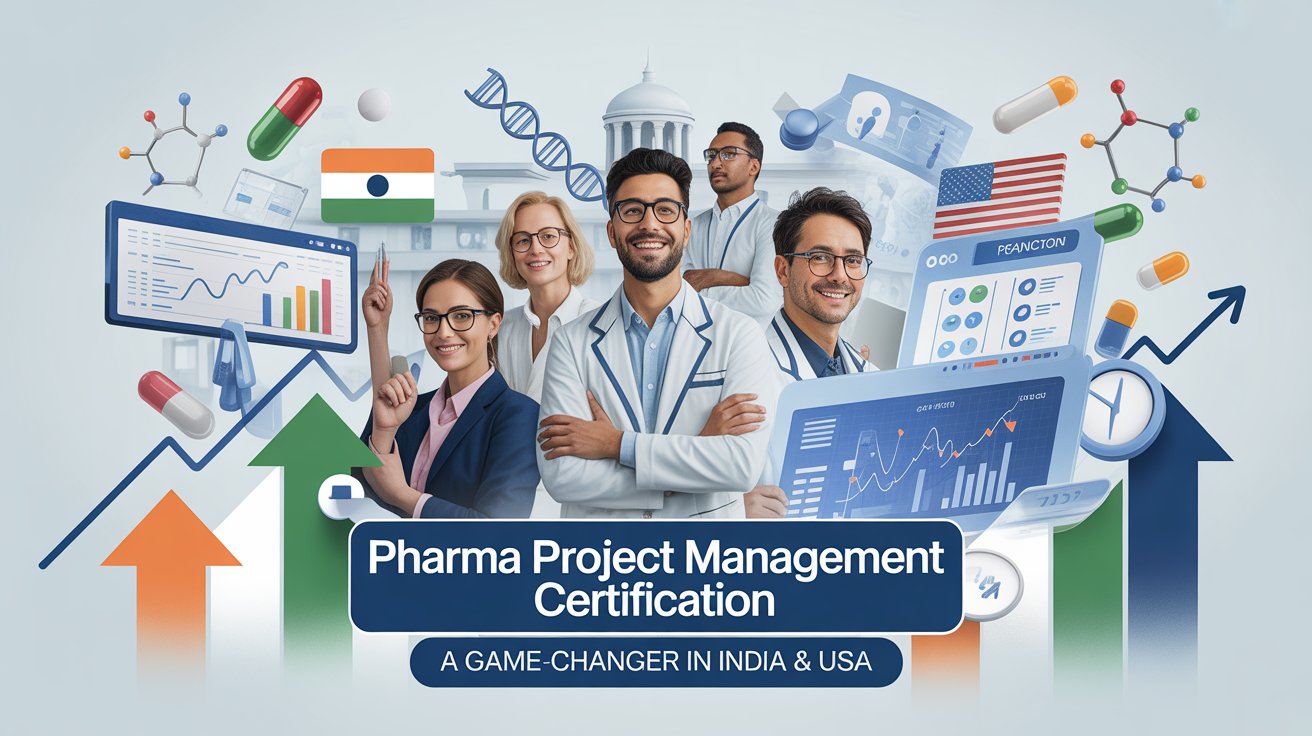
Why Pharma Project Management Certification Is a Game-Changer in India & USA
Introduction
The pharmaceutical industry is more dynamic — and competitive — than ever before. Between stringent regulations, complex R&D processes, and digital transformation, companies across India and the USA are seeking professionals who can lead projects with precision, compliance, and strategy.
That’s why pharma project management certification has emerged as one of the biggest career accelerators in the industry.
Whether you’re managing validation projects in India or leading clinical trials in the USA, certified project management skills can dramatically boost efficiency, compliance readiness, and leadership credibility.
In this article, we’ll explore why project management certification — especially PMP and pharma-focused programs — is a game-changer for pharma professionals, and how it’s shaping the next generation of leaders in both India and the United States.
1. What Is Pharma Project Management Certification?
A pharma project management certification is a professional credential that validates your ability to plan, execute, monitor, and close projects efficiently in a regulated pharmaceutical environment.
While general PMP® (Project Management Professional) training provides universal frameworks, pharma-specific programs integrate:
- GMP and GxP compliance principles
- Regulatory frameworks (FDA, EMA, WHO, CDSCO)
- Risk management and audit readiness
- Cross-functional collaboration between QA, QC, and production teams
📊 Stat: PMI research shows that companies with certified project managers meet their goals 30% more often and waste 10x less money on failed projects.
👉 For pharma professionals, this isn’t just a qualification — it’s a strategic edge in one of the most process-driven industries in the world.
2. Why Project Management Matters in the Pharma Industry
Pharma projects are highly complex — spanning clinical trials, product development, facility validation, regulatory filings, and tech transfers.
Without structured project management, these initiatives face:
- Cost overruns
- Delays in regulatory approvals
- Compliance failures
That’s why pharma project management certification provides the foundation for:
- Predictable project execution
- Audit-ready documentation
- Cross-functional efficiency
- Leadership-driven decision-making
💡 Example: A manufacturing engineer in Hyderabad applied PMP principles to a WHO-GMP compliance upgrade and reduced project completion time by 25%.
3. The India Perspective: Demand for Pharma Project Leaders
India — the “pharmacy of the world” — is one of the fastest-growing pharma markets, contributing 20% of global generic exports.
Challenges in India’s Pharma Projects:
- Rapid scale-up of manufacturing capacity.
- Frequent regulatory audits (USFDA, WHO, CDSCO).
- Short product development timelines.
Why Certification Matters:
Pharma project management certification helps Indian professionals:
- Master frameworks to manage complex compliance-driven projects.
- Bridge the gap between science and strategy.
- Lead teams with confidence during audits and inspections.
📊 Insight: Indian pharma companies are now prioritizing PMP-certified professionals for roles like Project Manager – QA Validation and Regulatory Affairs Lead.
💬 Case Example: A QA manager from Pune with PMP certification was promoted to Head of Quality Systems, leading cross-site compliance upgrades for EU clients.
4. The USA Perspective: Driving Innovation Through Project Management
In the USA, the pharmaceutical ecosystem is highly advanced but equally complex.
Key Challenges:
- Stringent FDA and EMA oversight.
- Rising costs of R&D and clinical trials.
- Cross-border team coordination across time zones.
Why Certification Matters:
Pharma project management certification gives American professionals:
- Tools for risk-based project planning in clinical and regulatory environments.
- Competence in digital project tracking tools (Power BI, Smartsheet, MS Project).
- The confidence to lead multi-site global projects.
💡 Example: A Clinical Operations Lead in Boston used PMP methodologies to streamline communication between CROs, reducing trial delays by 18% and increasing FDA submission accuracy.
5. Key Benefits of Pharma Project Management Certification
| Benefit | Impact on Career |
|---|---|
| Global Recognition | PMP and pharma certifications are respected across 200+ countries. |
| Higher Salaries | Certified project managers earn 20–40% more globally. |
| Faster Promotions | Professionals advance into leadership and cross-functional roles. |
| Regulatory Confidence | Stronger control over compliance, documentation, and CAPA. |
| Digital Integration | Ability to use data analytics for project tracking and decision-making. |
📈 Data: According to PMI, certified project managers in healthcare/pharma earn an average of $120,000 per year in the USA.
6. How Pharma Project Management Certification Boosts Compliance
Compliance is at the heart of pharma — and certifications equip professionals to handle it strategically.
Key Skills You Gain:
- Developing risk management plans.
- Implementing quality control systems aligned with GMP.
- Managing CAPA and deviation closure effectively.
- Creating audit-ready documentation and digital dashboards.
💡 Example: A certified professional in Vietnam used project management tools to automate validation tracking — improving audit outcomes by 30%.
7. The Roadmap: How to Get Pharma Project Management Certified
Step 1: Choose the Right Certification
Top options include:
- PMP® Certification (PMI) — Global gold standard.
- Lean Six Sigma for Pharma — Focuses on process efficiency.
- Pharma Project Management Certification Programs (India or USA-based).
Step 2: Check Eligibility
- Bachelor’s degree + 36 months of project experience.
- Or secondary degree + 60 months of experience.
Step 3: Enroll in a PMI-Authorized Training Partner (ATP)
Look for training that includes pharma case studies and GMP frameworks.
Step 4: Complete 35 Contact Hours of Training
Covers PMBOK (Project Management Body of Knowledge) principles.
Step 5: Pass the Exam
180 questions (230 minutes). Focus on People, Process, and Business Environment.
Step 6: Maintain Certification
Earn 60 PDUs (Professional Development Units) every 3 years.
8. Top Tools You’ll Learn in Pharma Project Management Training
✅ Gantt Charts & MS Project – for project scheduling.
✅ Risk Matrix – to manage regulatory and audit risks.
✅ Stakeholder Analysis – for team alignment.
✅ Earned Value Management (EVM) – for tracking cost vs. progress.
✅ Agile Methodologies – for R&D and clinical flexibility.
💡 Pro Tip: Learning to combine Agile with GMP documentation can make you an invaluable project leader in digital pharma operations.
9. Real-World Outcomes: Case Studies from India & USA
India:
A validation engineer in Ahmedabad completed a pharma PMP program.
- Reduced equipment qualification time by 25%.
- Was promoted to Project Manager – Quality Systems within 10 months.
USA:
A regulatory project coordinator in New Jersey implemented PMP risk analysis in pre-approval submissions.
- Decreased non-compliance issues by 40%.
- Earned recognition as Top Performing Project Lead.
📊 Result: Professionals with pharma project management certification are 3x more likely to achieve measurable improvements in project delivery.
10. The Future of Pharma Project Management
By 2030, pharma projects will be more digital, global, and cross-functional.
Emerging trends include:
- AI-driven project dashboards for quality management.
- Virtual audits and cloud-based validation systems.
- Data analytics for predictive compliance.
- Leadership emphasis on sustainability and innovation.
📈 Insight: PMI predicts that 2.3 million project management roles will open globally by 2030 — with pharma and healthcare among the top sectors.
👉 Professionals who pursue pharma project management certification now will be the industry’s future leaders.
Quick Recap: Why Certification Is a Game-Changer
✅ Builds regulatory and project confidence
✅ Enhances career and salary prospects
✅ Improves global mobility (India, USA, Vietnam, Nigeria)
✅ Prepares leaders for digital transformation in pharma
✅ Creates future-ready project managers
FAQs on Pharma Project Management Certification
1. Is PMP the best certification for pharma professionals?
Yes. PMP provides global credibility and teaches leadership and project frameworks relevant to pharma operations.
2. Can I take PMP training online?
Absolutely. Online programs with pharma-specific modules are available globally.
3. How long does it take to complete PMP training?
Typically 6–8 weeks of structured study, followed by the exam.
4. Is certification recognized in both India and the USA?
Yes — PMP and pharma project management certifications are universally recognized.
5. Do I need management experience to apply?
Basic project exposure (team coordination or audit preparation) is enough to qualify.
Conclusion: From Compliance to Leadership — The Future Is Certified
The next era of pharmaceutical leadership belongs to those who can balance technical expertise with project management mastery.
For professionals in India and the USA, pharma project management certification bridges this gap — transforming everyday roles into strategic, high-impact careers.
By investing in certification, you’re not just managing projects — you’re building a leadership legacy.
🚀 Call to Action:
Ready to accelerate your pharma career? Enroll in our Pharma Project Management Certification Program today and become a future-ready leader in India or the USA.

