No products in the cart.
GAMP 5 Validation Lifecycle: Key Phases and Essential Documentation (2026 Guide)
Introduction
Computerized systems are at the heart of today’s pharmaceutical and life sciences operations. Whether it’s a Quality Management System (QMS), LIMS, ERP, MES, or a simple spreadsheet used in production, regulators expect one thing:
👉 Every system impacting product quality or patient safety must be validated.
This is where GAMP 5 validation lifecycle becomes extremely important.
GAMP 5 (Good Automated Manufacturing Practice) is the globally recognized framework that guides organizations on how to validate computerized systems in a risk-based, scalable, and compliant manner. Whether you’re preparing for an FDA, EMA, WHO, or MHRA audit, understanding the GAMP 5 validation lifecycle is essential.
In this detailed guide, we will break down:
- Key phases of the GAMP 5 lifecycle
- Requirements for each stage
- Documentation needed
- V-model explained
- Real-world examples
- Common mistakes
- Best practices for audit readiness
Let’s dive deep into the world of system validation.
1. What Is GAMP 5? A Quick Refresher
GAMP 5 is a guideline published by ISPE (International Society for Pharmaceutical Engineering) that provides a structured approach to validating computerized systems used in GxP environments.
Purpose of GAMP 5:
- Ensure patient safety
- Maintain data integrity
- Reduce compliance risks
- Provide a risk-based validation approach
- Encourage scalable, practical validation
- Support electronic records & signatures (21 CFR Part 11 compliance)
💡 Primary Keyword Usage:
The GAMP 5 validation lifecycle provides organizations with a standardized framework to validate GxP-impact systems effectively.
2. Understanding the GAMP 5 Validation Lifecycle
The GAMP 5 validation lifecycle is based on the principle that validation is not a one-time task, but a continuously monitored and maintained process.
It includes:
- Concept Phase
- Project Phase (V-Model)
- Operation Phase
- Retirement Phase
This ensures the system remains compliant from procurement to retirement.
3. Key Phases of the GAMP 5 Validation Lifecycle
Let’s break down each phase, its activities, and required documentation.
PHASE 1: CONCEPT / INITIAL PLANNING
This phase sets the foundation for everything that follows.
It answers: Do we need this system? What risks will it introduce?
Activities:
- Define the business need
- Identify system intended use
- Conduct preliminary risk assessment
- Determine GAMP software category
- Create initial validation strategy
Deliverables & Documentation:
- Business Requirements Document (BRD)
- User Requirement Specifications (URS) draft
- Validation Plan (VP)
- Risk Assessment (RA) – initial
- Supplier assessment strategy
💡 Tip: A clear URS is essential. If the URS is weak, the entire GAMP 5 validation lifecycle becomes inefficient.
PHASE 2: PROJECT PHASE (V-MODEL)
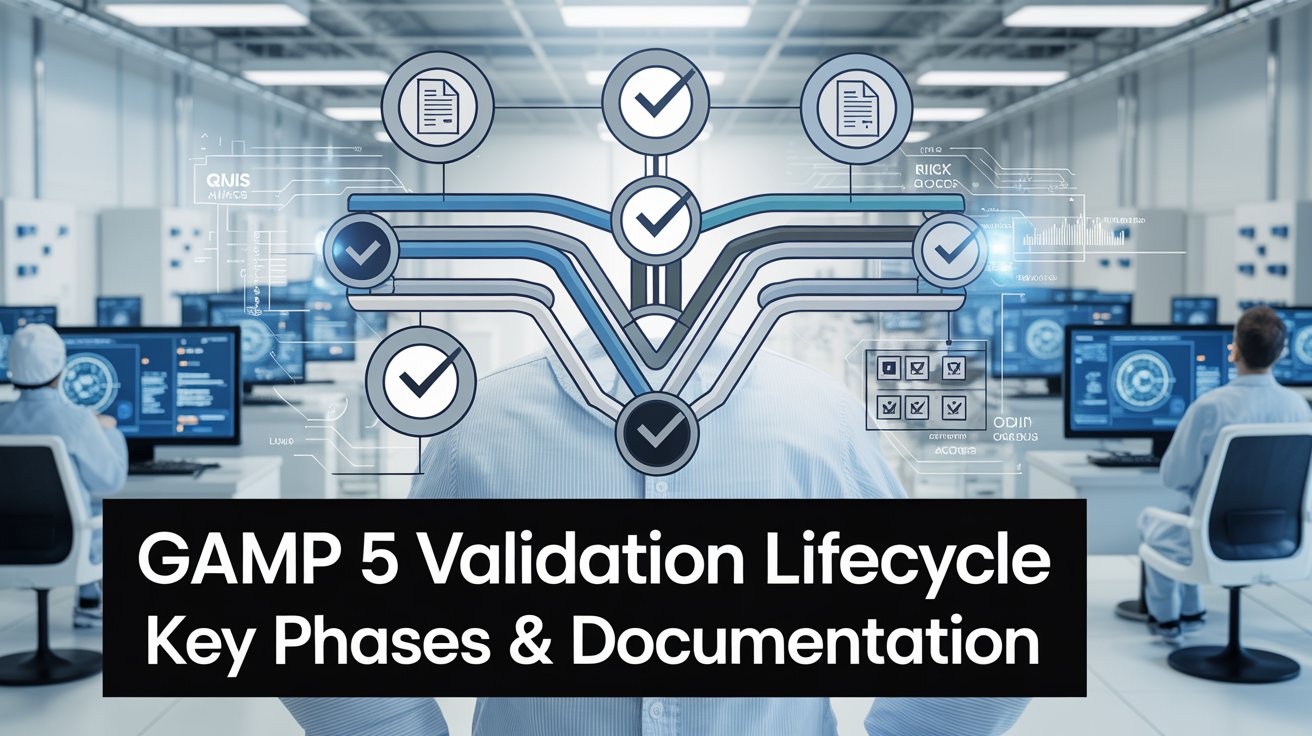
The iconic V-model is the backbone of GAMP 5.
It creates a direct link between requirements → testing.
Let’s go through each stage:
A. User Requirement Specification (URS)
Purpose:
Defines what the system must do, not how it will do it.
Examples:
- “The system must support electronic signatures (Part 11).”
- “Audit trail must be tamper-proof and accessible for 5 years.”
B. Functional Specification (FS)
Purpose:
Details how the system will fulfill requirements.
Examples:
- Workflow diagrams
- Field-level rules
- Formula validation logic
C. Design Specification (DS)
Contains:
- Hardware design
- Database structure
- Network architecture
- Security design
- Backup and restore plans
D. Configuration & System Build
This is where the vendor configures the system based on approved FS/DS.
E. Testing Activities (IQ/OQ/PQ)
These form the backbone of validation.
1. Installation Qualification (IQ)
Ensures system is installed correctly.
IQ verifies:
- Software installation
- Server configuration
- System access
- Version control
2. Operational Qualification (OQ)
Tests whether system functions as intended—based on FS.
Examples:
- Audit trail functioning
- Date/time stamping
- Error messages
3. Performance Qualification (PQ)
Tests whether the system performs in a real-world environment.
Example:
- Multi-user transactions
- Real batch data execution
📌 Primary Keyword Usage:
The testing activities (IQ/OQ/PQ) are critical in the GAMP 5 validation lifecycle because they demonstrate system suitability for GxP operations.
PHASE 3: OPERATIONAL / LIVE USE
Once the system goes live, validation activities don’t stop.
This phase ensures continuous compliance.
Activities:
- Periodic reviews
- Change control
- Training management
- CAPA handling
- Incident/deviation management
- Backup and disaster recovery validation
Documentation Required:
- SOPs for system usage
- Training records
- Change control forms
- Incident & deviation logs
- Periodic review reports
💡 Tip: The operation phase is the most neglected part of the GAMP 5 validation lifecycle—but it’s where most audit findings occur.
PHASE 4: RETIREMENT
No system lasts forever.
When retiring:
- Data must be archived
- Access must be restricted
- System must be decommissioned safely
Documentation Required:
- Decommissioning Plan
- Data Migration Report
- System Retirement Report
4. GAMP 5 Documentation Checklist (Complete)
Here is the full list of documentation needed:
Planning Phase
- Business Requirements
- Validation Plan
- Risk Assessment (initial)
Project Phase (V-Model)
- URS
- FS
- DS
- Configuration Specification
- IQ Protocol & Report
- OQ Protocol & Report
- PQ Protocol & Report
- Traceability Matrix
- Data Migration Plan
- Supplier Audit Report
Operational Phase
- SOPs
- Periodic Review Reports
- Access Control Logs
- Backup Verification Logs
- Incident & CAPA Logs
- Change Control Records
Retirement Phase
- Decommissioning Plan
- Archived Data Verification
- Validation Summary Report
5. Real-World Example: GAMP 5 Implementation in a Pharma Company
A mid-sized pharma company implemented a new LMS (Learning Management System).
Challenges:
- Paper-based training
- Audit trail risks
- Inconsistent training records
Solution Using GAMP 5 Validation Lifecycle:
- Clear URS with compliance needs
- Risk-based testing
- Automated training & digital signatures
- Annual periodic reviews
Outcome:
- 100% audit compliance
- 70% reduction in training errors
- FDA praised system traceability
6. Common Mistakes to Avoid in GAMP 5 Validation Lifecycle
🚫 Poorly written URS
🚫 Missing traceability matrix
🚫 Over-testing low-risk areas
🚫 Not involving end-users
🚫 Weak vendor assessments
🚫 Lack of change control discipline
🚫 Missing periodic reviews
7. Best Practices for Smooth GAMP 5 Validation
✔ Adopt risk-based testing
Validate high-risk functions deeper.
✔ Maintain traceability
URS → Test cases → Reports.
✔ Use templates
Speeds up documentation.
✔ Train system users
Reduces deviations after go-live.
✔ Perform mock audits
Ensures audit readiness.
✔ Partner with experienced CSV experts
Avoid costly gaps in validation.
8. Summary: Why GAMP 5 Validation Lifecycle Matters
The GAMP 5 validation lifecycle ensures:
- Compliance with global GMP guidelines
- Data integrity protection
- Reliable system performance
- Reduction in audit findings
- Efficient delivery of computerized systems
In regulated environments, following GAMP 5 is not optional—it’s essential.
FAQs: GAMP 5 Validation Lifecycle
1. What is the purpose of GAMP 5?
To ensure computerized systems are validated and compliant using a risk-based approach.
2. What are the most important documents in the GAMP 5 lifecycle?
URS, risk assessment, IQ/OQ/PQ, traceability matrix, and SOPs.
3. Does every system need PQ testing?
Only GxP-impact systems require PQ.
4. How often should periodic reviews be done?
Once a year or whenever major changes occur.
5. Does GAMP 5 apply only to pharma?
No. It applies to all GxP industries including biotech, medical devices, and healthcare.
Conclusion
The GAMP 5 validation lifecycle is the backbone of computerized system validation in modern pharmaceuticals. By understanding its phases and documentation requirements, organizations can ensure high compliance, audit readiness, and operational excellence.
Whether implementing a new QMS, ERP, MES, LIMS, or digital tool, following GAMP 5 ensures systems are reliable, compliant, and robust.
🚀 Call to Action:
Need help validating your computerized systems? Explore our GAMP 5 Validation & CSV Consulting Services to ensure end-to-end compliance.

