
No products in the cart.
How to Validate HVAC Systems in cGMP Environments: A Complete 2026 Guide
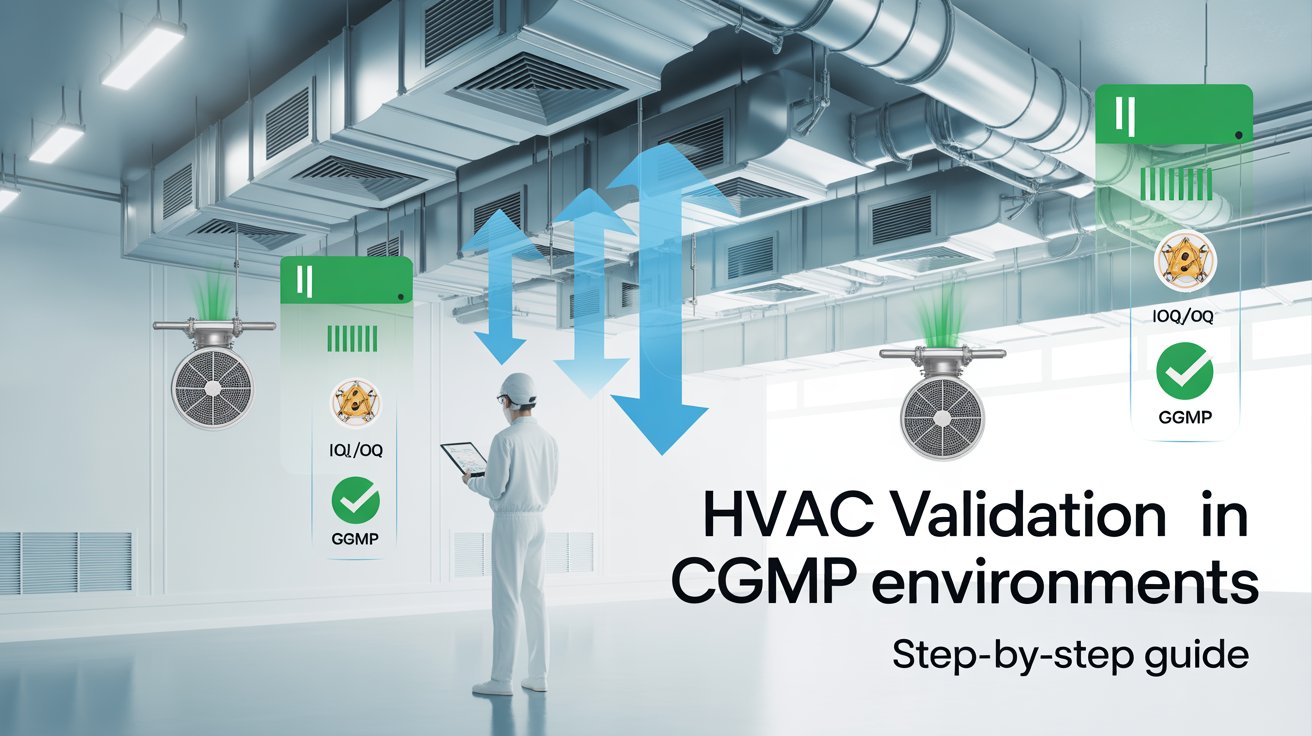
Introduction
In pharmaceutical manufacturing, every product must be made in a controlled, clean, and safe environment. One of the most critical systems responsible for maintaining that environment is the HVAC system — which controls temperature, humidity, differential pressure, airflow, filtration, and overall cleanroom performance.
Regulators like the US FDA, EMA, MHRA, and WHO expect that all critical systems impacting product quality be validated. That’s why knowing how to validate HVAC systems in cGMP environments is essential for quality teams, engineering teams, validation experts, and facility managers.
This comprehensive guide breaks down HVAC validation step-by-step — including IQ/OQ/PQ, key tests, documentation, regulatory expectations, and common mistakes to avoid.
Let’s dive in.
1. Why HVAC Validation Is Essential in cGMP Environments
The HVAC system plays a direct role in controlling product quality and patient safety.
A properly validated HVAC system ensures:
- ✔ Correct cleanroom classification (ISO 5–ISO 8)
- ✔ Stable temperature and humidity
- ✔ Controlled differential pressure
- ✔ Uniform airflow
- ✔ HEPA filtration integrity
- ✔ Prevention of cross-contamination
- ✔ Consistent microbial and particle control
💡 Primary keyword usage:
To meet regulatory expectations, you must understand how to validate HVAC systems in cGMP environments using a structured, documented, and risk-based approach.
2. Regulatory Expectations for HVAC Validation
Global regulatory bodies directly link HVAC performance to product quality.
Key guidelines:
- WHO Technical Report Series 1019 & 957
- EU GMP Annex 1 (sterile manufacture)
- EU GMP Part 1 & Part 2
- US FDA Guidance on Sterile Drug Products
- ISO 14644 Cleanroom Standards
- ASHRAE Standards
- ISPE Baseline Guide (Volume 3 – HVAC)
Regulators expect companies to:
- Validate all HVAC parameters impacting quality
- Maintain traceable documentation
- Use calibrated instruments
- Demonstrate ongoing monitoring
3. Understanding the HVAC Validation Lifecycle
Validation follows the traditional CSV lifecycle:
- Design Qualification (DQ)
- Installation Qualification (IQ)
- Operational Qualification (OQ)
- Performance Qualification (PQ)
- Periodic Review & Requalification
Let’s break down each stage.
4. Step-by-Step Guide: How to Validate HVAC Systems in cGMP Environments
This is the main section — explaining exactly how to validate HVAC systems.
Step 1: Design Qualification (DQ)
DQ ensures the design is appropriate for its intended use.
Check the following in DQ:
- URS — User Requirement Specification
- HVAC system design layout
- Cleanroom classification
- AHU design capacity
- HEPA filter specifications
- Airflow patterns
- Environmental conditions (temp, RH)
- Differential pressure strategy
- Return air system and exhaust design
Output Documents:
- DQ Report
- Approved URS
- Vendor design documents
Step 2: Installation Qualification (IQ)
IQ verifies that the HVAC system is installed correctly, according to design and specifications.
Typical IQ Checks:
- AHU model & tag verification
- Correct installation of chillers, ducts, motors
- Electrical supply verification
- Calibration of sensors (temperature, RH, pressure)
- HEPA filter serial number verification
- Duct integrity testing
- Installed instrument list
- P&ID compliance
- Spare parts documentation
Deliverables:
- IQ Protocol & Report
- As-built drawings
- Calibration certificates
- Vendor manuals
Step 3: Operational Qualification (OQ)
OQ ensures the HVAC system operates within defined parameters.
Core OQ Tests Include:
1. Airflow Velocity & Air Changes per Hour (ACH)
- Laminar airflow velocities (for Grade A & B)
- Turbulent airflow measurements (for Grade C & D)
- ACH calculations
2. Differential Pressure Measurements
Ensure pressure cascades between rooms:
- Critical → less critical → corridor
Typical difference: 10–15 Pa
3. Temperature & Humidity Tests
Examples:
- Class C: 18–25°C
- RH controlled between 30–60%
(May vary based on product requirements)
4. HEPA Filter Integrity Test (DOP/PAO Test)
- Leak detection
- Filter integrity compliance
Must follow ISO 14644-3 guidelines.
5. Airflow Visualization (Smoke Studies)
To confirm:
- Unidirectional airflow
- No turbulence
- No backflow
- No dead pockets
6. Alarm & Control System Testing
- BMS alarms
- Controller setpoints
- Auto shutdown/reset logic
Deliverables:
- OQ Protocol & Report
- HEPA integrity test report
- Airflow pattern videos
- Temperature & RH qualification data
Step 4: Performance Qualification (PQ)
PQ demonstrates that HVAC performs consistently in real operational conditions.
Typical PQ Tests:
1. Non-Viable Particle Count (NVPC)
Performed at rest & in operation:
- ISO 5
- ISO 7
- ISO 8
2. Viable Microbial Monitoring
- Settle plates
- Active air sampling
- Surface swabs
3. Recovery Testing
How quickly cleanroom returns to required class after disturbance.
4. Occupancy Load Study
To test the system under real-world usage.
Deliverables:
- PQ Report
- Microbial trend analysis
- Particle count reports
5. Critical Tests During HVAC Validation
Here is a consolidated list of key tests performed:
During IQ:
- Verification of components
- Calibration documents
- Drawing verification
- P&ID confirmation
During OQ:
- HEPA leak test
- Airflow velocity
- ACH
- Temperature and humidity
- Differential pressure
- Airflow visualization
- BMS alarms
During PQ:
- NVPC
- Viable monitoring
- Recovery test
- Containment test
- Cleanroom classification
These tests form the backbone of understanding how to validate HVAC systems in cGMP environments.
6. Essential Documentation for HVAC Validation
Documentation is EVERYTHING in validation.
Required Documents:
- Validation Plan
- URS
- DQ / IQ / OQ / PQ
- Calibration certificates
- Test reports
- Maintenance logs
- HVAC BMS data
- SOPs:
- HVAC operation
- HVAC cleaning
- Change control
- Deviation and CAPA handling
- Risk assessment (FMEA or HACCP)
- Traceability matrix
- Validation Summary Report
💡 Regulators often say:
“If it’s not documented, it didn’t happen.”
7. Common Mistakes Companies Make During HVAC Validation
🚫 Poor-quality URS
🚫 Incorrect pressure cascades
🚫 Missing airflow visualization
🚫 Improper HEPA installation
🚫 Not testing at “at rest” & “in operation”
🚫 No trending of environmental data
🚫 Ignoring filter leakages
🚫 Not validating BMS alarms
🚫 No requalification schedule
These pitfalls often result in FDA 483 observations, Warning Letters, and EU GMP Non-Compliances.
8. Best Practices for HVAC Validation (2025 Updated)
✔ Follow a risk-based approach
Focus more on critical parameters.
✔ Validate sensors & instruments first
Faulty sensors = faulty data.
✔ Perform smoke studies during media fills
Especially Grade A/B areas.
✔ Use calibrated particle counters only
Follow ISO 21501-4.
✔ Trend environmental conditions
Daily → Weekly → Monthly → Quarterly.
✔ Revalidate after major changes
Examples:
- AHU replacement
- Filter replacement
- Layout change
✔ Maintain digital logs
Use Power BI or BMS dashboards.
9. Who Should Read This Guide?
This guide is written for:
- QA & QC professionals
- Engineering heads
- Validation engineers
- HVAC technicians
- Compliance managers
- Pharma auditors
- Facility managers
Anyone involved with cleanrooms, utilities, or facility qualification will benefit from learning how to validate HVAC systems in cGMP environments.
10. Real-World HVAC Validation Case Study
Scenario:
A sterile injectable plant failed an FDA audit due to airflow issues in Grade A areas.
Problems Identified:
- Wrong pressure gradient
- HEPA leak not detected
- Improper airflow patterns
Validation Solution:
- Revalidated using risk-based approach
- Performed smoke tests in all Grade A/B rooms
- Rebalanced airflow
- Documented all test results
- Implemented continuous monitoring
Results:
- Passed follow-up FDA inspection
- 65% reduction in environmental deviations
- Increased confidence in sterile suite performance
11. FAQs: HVAC Validation in cGMP Environments
1. How often should HVAC be revalidated?
Typically annually or after any major system change.
2. Is HEPA filter testing mandatory?
Yes — FDA & WHO consider it critical for sterile and non-sterile areas.
3. Which cleanrooms require stricter HVAC validation?
Grade A and Grade B zones.
4. What standards apply to cleanroom classification?
ISO 14644-1 and ISO 14644-2.
5. Who approves HVAC validation documents?
QA, Engineering, and Validation heads.
Conclusion
HVAC validation is one of the most critical components of cGMP compliance. A well-validated HVAC system ensures controlled environments, protects product quality, supports audit readiness, and prevents contamination risks.
By following a structured lifecycle — DQ, IQ, OQ, PQ — and maintaining robust documentation, companies can ensure their facilities remain compliant, efficient, and safe.
This guide gives you everything needed to learn how to validate HVAC systems in cGMP environments, including step-by-step testing, documentation, and best practices.
🚀 Call to Action:
Ready to upgrade your HVAC validation program? Enroll in our HVAC & Facility Validation Masterclass to learn templates, protocols, and real-world execution techniques trusted by global pharma companies.

