No products in the cart.
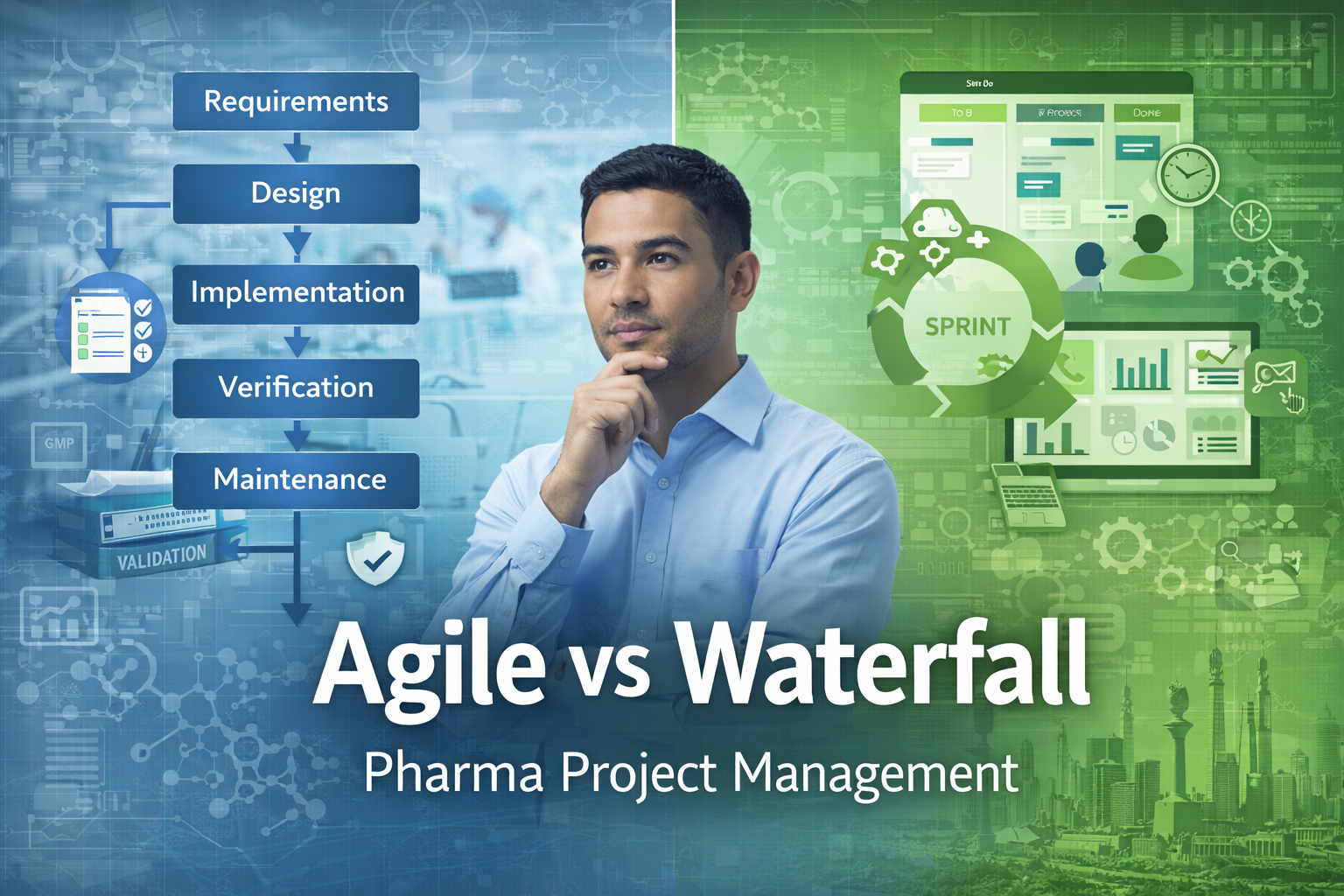
Agile vs Waterfall in Pharma Projects: How to Choose the Right Project Management Approach
Introduction: Why This Debate Matters in Pharma Today
The pharmaceutical industry is undergoing a massive shift. Digital transformation, AI adoption, accelerated timelines, global audits, and increasing regulatory scrutiny have changed how pharma projects are planned and executed.
One of the most important decisions pharma professionals must make today is choosing between Agile vs Waterfall in pharma projects.
Choosing the wrong approach can lead to:
- Regulatory delays
- Failed audits
- Budget overruns
- Missed market timelines
Choosing the right approach can result in:
- Faster project execution
- Better compliance control
- Stronger cross-functional collaboration
- Career growth into leadership roles
This guide explains Agile vs Waterfall in pharma projects with real-world pharma examples, regulatory perspectives, and a clear decision framework especially for professionals looking to upskill through programs like The Pharma Architect Master Class.
Understanding Waterfall Project Management in Pharma
What Waterfall Project Management Means
Waterfall is a sequential project management approach where each phase must be completed before moving to the next. It is documentation-heavy and milestone-driven, making it historically popular in regulated industries.
Typical Waterfall phases in pharma include:
- Requirement definition
- Design and documentation
- Execution and installation
- Validation and testing
- Deployment
- Audit and project closure
Why Waterfall Works Well in Pharma Projects
Waterfall aligns naturally with pharmaceutical regulations and inspection expectations.
Key advantages include:
- Strong documentation and traceability
- Clear validation lifecycle alignment
- Predictable timelines
- Easier audit readiness
- Clear accountability
Waterfall is ideal for:
- GMP facility construction
- HVAC and water system validation
- Equipment qualification (DQ, IQ, OQ, PQ)
- Technology transfer projects
- Regulatory submissions
- Manufacturing plant expansions
Regulators prefer Waterfall-style execution because it aligns with:
- US FDA expectations
- EU GMP and Annex 1
- WHO GMP guidelines
- GAMP 5 lifecycle models
Limitations of Waterfall in Modern Pharma Environments
Despite its strengths, Waterfall has limitations:
- Low flexibility to change
- Late discovery of issues
- Slower feedback cycles
- Less suitable for digital and analytics projects
This is where Agile starts to play a role in Agile vs Waterfall in pharma projects discussions.
Understanding Agile Project Management in Pharma
What Agile Project Management Is
Agile is an iterative and incremental approach that focuses on:
- Short execution cycles (sprints)
- Continuous stakeholder feedback
- Cross-functional collaboration
- Early value delivery
Agile emphasizes adaptability without losing control.
Can Agile Really Work in Pharma?
Yes, when implemented correctly.
Agile works best in pharma for:
- Digital transformation projects
- Power BI and Tableau dashboards
- AI and analytics initiatives
- Automation pilots
- Computer System Validation (CSV) using Agile GAMP 5 models
- Data integrity remediation
Agile in pharma does not mean skipping documentation.
It means documenting incrementally and intelligently.
Benefits of Agile in Pharma Projects
- Faster decision-making
- Early risk identification
- Better alignment between business and IT
- Flexibility during regulatory changes
- Improved stakeholder satisfaction
This is why the conversation around Agile vs Waterfall in pharma projects is now a practical necessity, not a theory.
Agile vs Waterfall in Pharma Projects: Side-by-Side Comparison
| Aspect | Waterfall | Agile |
|---|---|---|
| Regulatory alignment | Very strong | Strong if structured |
| Documentation | Heavy upfront | Incremental |
| Flexibility | Low | High |
| Change handling | Difficult | Built-in |
| Digital projects | Limited | Excellent |
| Audit readiness | Strong | Requires discipline |
| Speed to value | Slower | Faster |
The most successful pharma professionals do not choose one blindly—they master both.
How Regulators View Agile and Waterfall in Pharma Projects
Regulators do not mandate project management methodologies. They mandate:
- Control
- Traceability
- Data integrity
- Risk management
- Compliance
Agile is acceptable when:
- Requirements are traceable
- Validation is lifecycle-based
- Changes are controlled
- Documentation supports decisions
Many global regulators now accept Hybrid Agile-Waterfall models, especially for digital initiatives.
This hybrid approach is a key focus area in The Pharma Architect Master Class, where professionals learn how to implement Agile safely in regulated environments.
Real-World Pharma Examples
GMP Facility Expansion
- Fixed scope
- Heavy validation
- Regulatory milestones
Best approach: Waterfall
QA Power BI Dashboard
- Iterative reporting
- Continuous feedback
- Rapid value delivery
Best approach: Agile
AI-Based Predictive Maintenance
- Agile for model development
- Waterfall for validation and deployment
Best approach: Hybrid
These examples clearly show why understanding Agile vs Waterfall in pharma projects is essential.
Hybrid Project Management: The Future of Pharma
Most modern pharma organizations use a Hybrid approach:
- Waterfall for compliance-critical foundations
- Agile for innovation and digital layers
This allows companies to:
- Stay compliant
- Move faster
- Reduce project risk
- Improve ROI
Hybrid execution is quickly becoming the industry standard.
Career Impact of Mastering Agile and Waterfall in Pharma
Professionals who understand Agile vs Waterfall in pharma projects:
- Get promoted faster
- Lead global and digital projects
- Handle regulatory pressure confidently
- Transition into leadership roles
This is why pharma-specific project management education is becoming a career necessity.
How The Pharma Architect Master Class Helps You Master Both
The Pharma Architect Master Class is built specifically for regulated pharma professionals and covers:
- Practical project management frameworks
- Agile, Waterfall, and Hybrid decision models
- PMP-aligned thinking for pharma
- Digital transformation use cases
- GAMP 5 and 21 CFR Part 11 alignment
- Real pharma case studies
👉 Master Class: https://gauravdakshini.com/courses/the-pharma-architect-master-class/
Frequently Asked Questions
Is Agile allowed in regulated pharma environments?
Yes, if implemented with proper validation, documentation, and risk control.
Which is better for pharma projects—Agile or Waterfall?
Neither universally. The correct choice depends on project type and regulatory risk.
Should pharma professionals learn both approaches?
Yes. Senior and global roles demand flexibility and hybrid thinking.
Is PMP useful for pharma professionals?
Yes. PMP concepts align strongly with structured, compliant project execution.
Final Thoughts: Choose Smart, Not Sides
The debate around Agile vs Waterfall in pharma projects is not about picking a favorite methodology.
It is about:
- Understanding project context
- Managing regulatory risk
- Delivering value faster
- Remaining audit-ready
The future belongs to pharma professionals who can blend structure with speed.
Call to Action
Want to master Agile, Waterfall, and Hybrid project execution in pharma?
👉 Enroll in The Pharma Architect Master Class and become a future-ready pharma project leader.
🔗 https://gauravdakshini.com/courses/the-pharma-architect-master-class/

