No products in the cart.
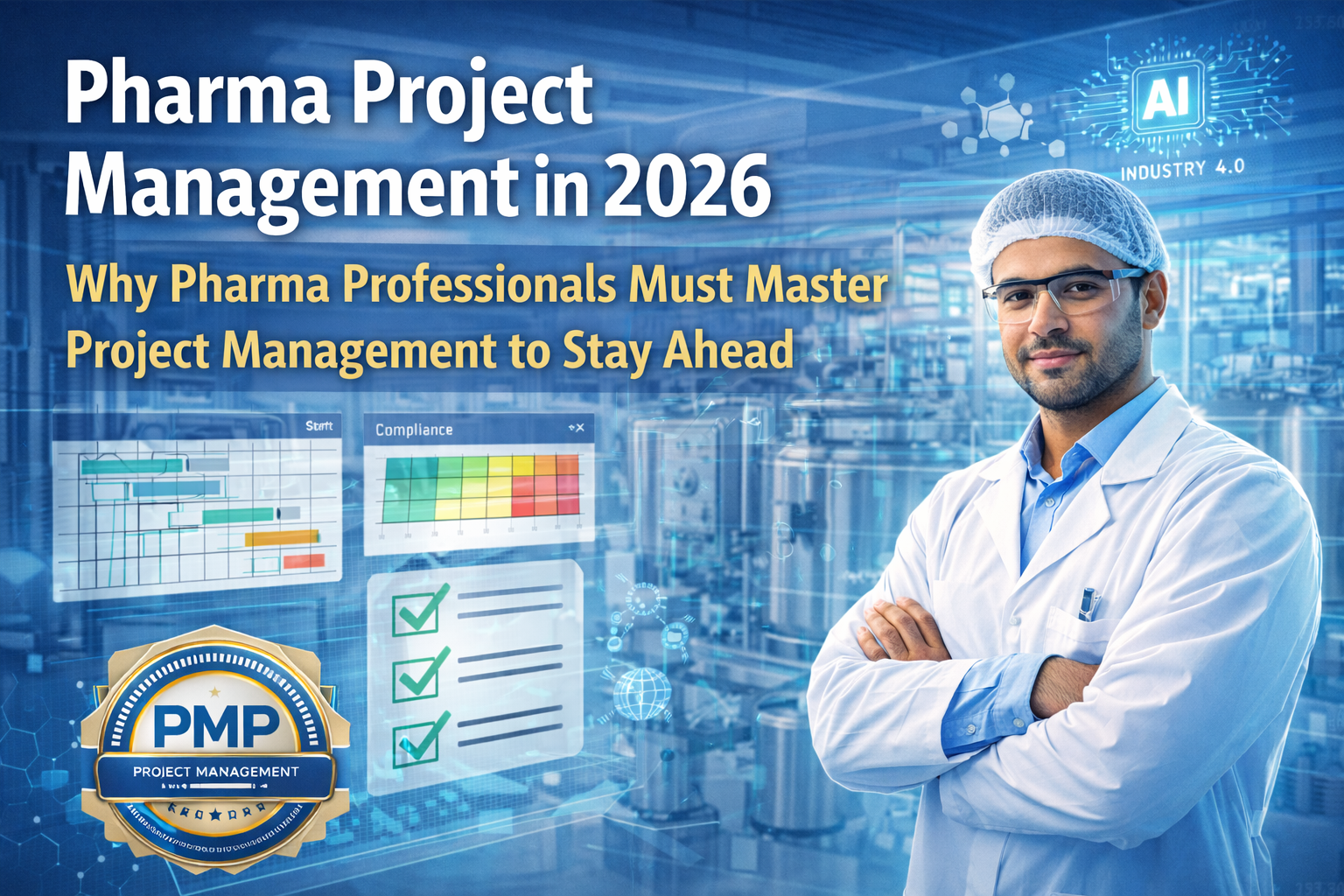
Pharma Project Management in 2026: Why Pharma Professionals Must Master Project Management to Stay Ahead
The pharmaceutical industry is entering a defining decade.
Regulations are tightening.
Technology is evolving faster than ever.
Digital transformation is no longer optional.
And in this environment, Pharma Project Management in 2026 has become one of the most critical skills for career survival and growth.
Whether you work in QA, QC, Engineering, Validation, Production, Automation, or Regulatory Affairs — your success will increasingly depend on how well you can manage projects, not just perform technical tasks.
Let’s explore why mastering project management is now mandatory for pharma professionals.
The Pharma Industry Is Becoming Project-Driven
Earlier, pharma roles were largely function-based:
- QA handled documentation
- Engineering handled equipment
- Production handled batches
- Regulatory handled submissions
But in 2026, pharma companies operate through projects such as:
- Greenfield plant setup
- Sterile facility upgrades
- HVAC redesigns
- Industry 4.0 implementation
- AI/ML integration
- 21 CFR Part 11 compliance
- GAMP 5 remediation
- Data integrity transformation
Each initiative requires:
- Structured planning
- Risk management
- Budget control
- Stakeholder alignment
- Execution discipline
That is why Pharma Project Management in 2026 is not optional — it is essential.
Why Technical Skills Alone Are No Longer Enough
You may be:
- A strong validation engineer
- A skilled QA auditor
- An experienced automation professional
But if you cannot:
- Control scope creep
- Manage cross-functional teams
- Track schedule variance
- Handle vendor negotiations
- Align stakeholders
You will struggle to move into leadership.
Project management bridges the gap between:
Technical Expert → Strategic Leader
5 Reasons Pharma Professionals Must Master Project Management in 2026
1️⃣ Regulatory Compliance Is Project-Based
Compliance programs are no longer routine tasks.
Examples:
- EU Annex 1 sterile upgrades
- 21 CFR Part 11 implementation
- Data integrity CAPA programs
- Facility redesigns
These are structured compliance projects.
Without project management:
- Timelines slip
- Audit observations increase
- Budgets explode
- Teams become misaligned
Mastering Pharma Project Management in 2026 helps professionals:
✔ Plan compliance upgrades
✔ Execute validation efficiently
✔ Track audit readiness
✔ Reduce regulatory risk
2️⃣ Industry 4.0 in Pharma Requires Structured Execution
Digital transformation is transforming pharma through:
- AI-based predictive maintenance
- Digital twins
- BMS, EMS, CDMS integration
- Smart dashboards
- Real-time monitoring
But digital tools fail without structured execution.
Implementation requires:
- Risk analysis
- Change management
- Procurement strategy
- Schedule optimization
This is where project management becomes critical.
3️⃣ Salary and Career Growth Are Linked to Leadership
Organizations promote professionals who:
- Deliver projects
- Control cost overruns
- Reduce compliance risk
- Drive cross-functional initiatives
In 2026, promotion criteria increasingly include:
- Strategic thinking
- Risk management capability
- Leadership visibility
Mastering Pharma Project Management in 2026 directly impacts:
- Faster promotions
- Higher compensation
- International opportunities
- Consulting prospects
4️⃣ Cross-Functional Alignment Is Now Mandatory
A pharma project includes stakeholders such as:
- QA
- QC
- Engineering
- Automation
- Production
- Procurement
- Regulatory
Without structured stakeholder engagement:
- Conflicts increase
- Delays occur
- Budgets inflate
Strong communication management ensures alignment.
5️⃣ Risk Management Is Now a Leadership Skill
Pharma projects are high-risk:
- Contamination risk
- Regulatory risk
- Vendor dependency risk
- Timeline risk
Professionals must understand:
- Risk registers
- Qualitative and quantitative risk assessment
- Monte Carlo simulation
- Contingency planning
Risk management is a core pillar of modern project management.
Real-World Example: HVAC Upgrade for Injectable Plant
Imagine your organization plans to upgrade HVAC systems for sterile compliance.
Without structured management:
- Scope changes frequently
- Budget overruns occur
- Validation overlaps improperly
- Production downtime increases
With structured project management:
✔ Clear project charter
✔ Defined WBS
✔ Critical path analysis
✔ CPI & SPI tracking
✔ Integrated change control
Result:
- On-time delivery
- Audit-ready facility
- Controlled cost
This is the power of mastering project management in pharmaceutical industry.
The Rise of the Pharma Architect
In 2026, companies are not just looking for engineers.
They are looking for:
- Project leaders
- Compliance strategists
- Digital transformation drivers
- Cross-functional architects
The future belongs to professionals who combine:
Technical mastery + Project management + Digital thinking
This integrated approach defines the modern Pharma Architect.
Skills Every Pharma Professional Must Develop in 2026
🔹 Integration Management
Aligning scope, cost, and schedule.
🔹 Scope & Change Control
Managing scope creep and gold plating.
🔹 Schedule Management
WBS, work packages, fast tracking, crashing.
🔹 Cost Management
Earned Value Analysis (EVA), CPI & SPI.
🔹 Quality Management
Cost of quality and audit readiness.
🔹 Risk Management
Quantitative & qualitative assessment.
🔹 Stakeholder Engagement
Managing influence and expectations.
These are not optional skills anymore.
They define leadership readiness.
Why Learning Generic Project Management Is Not Enough
Pharma is highly specialized.
You need domain-integrated training that includes:
- CGMP
- HVAC
- Facility design
- Regulatory guidelines
- GAMP 5
- 21 CFR Part 11
- Industry 4.0
- AI/ML use cases
Programs like the Pharma Architect Masterclass integrate:
✔ Practical project management workshop
✔ Regulatory audit mastery
✔ Digital transformation
✔ 100+ real-life case studies
✔ AI/ML implementation examples Skillup to Scaleup Broacher ATP…
That’s the difference between theory and real-world capability.
How Pharma Project Management in 2026 Future-Proofs Your Career
Mastering this skill enables you to:
- Lead greenfield projects
- Execute brownfield upgrades
- Handle global audits
- Implement digital dashboards
- Consult independently
It increases:
- Professional visibility
- Strategic influence
- Leadership credibility
Frequently Asked Questions (FAQ)
Q1: Is project management necessary for QA or regulatory professionals?
Yes. Compliance initiatives are structured projects requiring planning and risk management.
Q2: Can engineers transition into leadership roles?
Absolutely. Project management is the bridge from execution to strategy.
Q3: Does it help internationally?
Yes. Structured project management is globally recognized.
Q4: Is this useful for mid-career professionals?
Especially useful. It accelerates promotion and salary growth.
Q5: Where should I learn pharma-specific project management?
Choose programs that integrate technical pharma knowledge with structured project frameworks.
Final Thoughts: 2026 Is a Turning Point
The pharma industry is evolving rapidly.
Those who remain functionally limited will struggle.
Those who master Pharma Project Management in 2026 will lead transformation.
This is not just about managing tasks.
It is about architecting systems.
It is about leading change.
It is about building future-ready pharma organizations.
If you are serious about leadership, innovation, and long-term career growth — now is the time to act.
Explore integrated programs that combine project management, compliance, digital transformation, and AI in pharma.
The future belongs to the Pharma Architect.
Your trusted partner for pharma skills, systems, and solutions.

