No products in the cart.
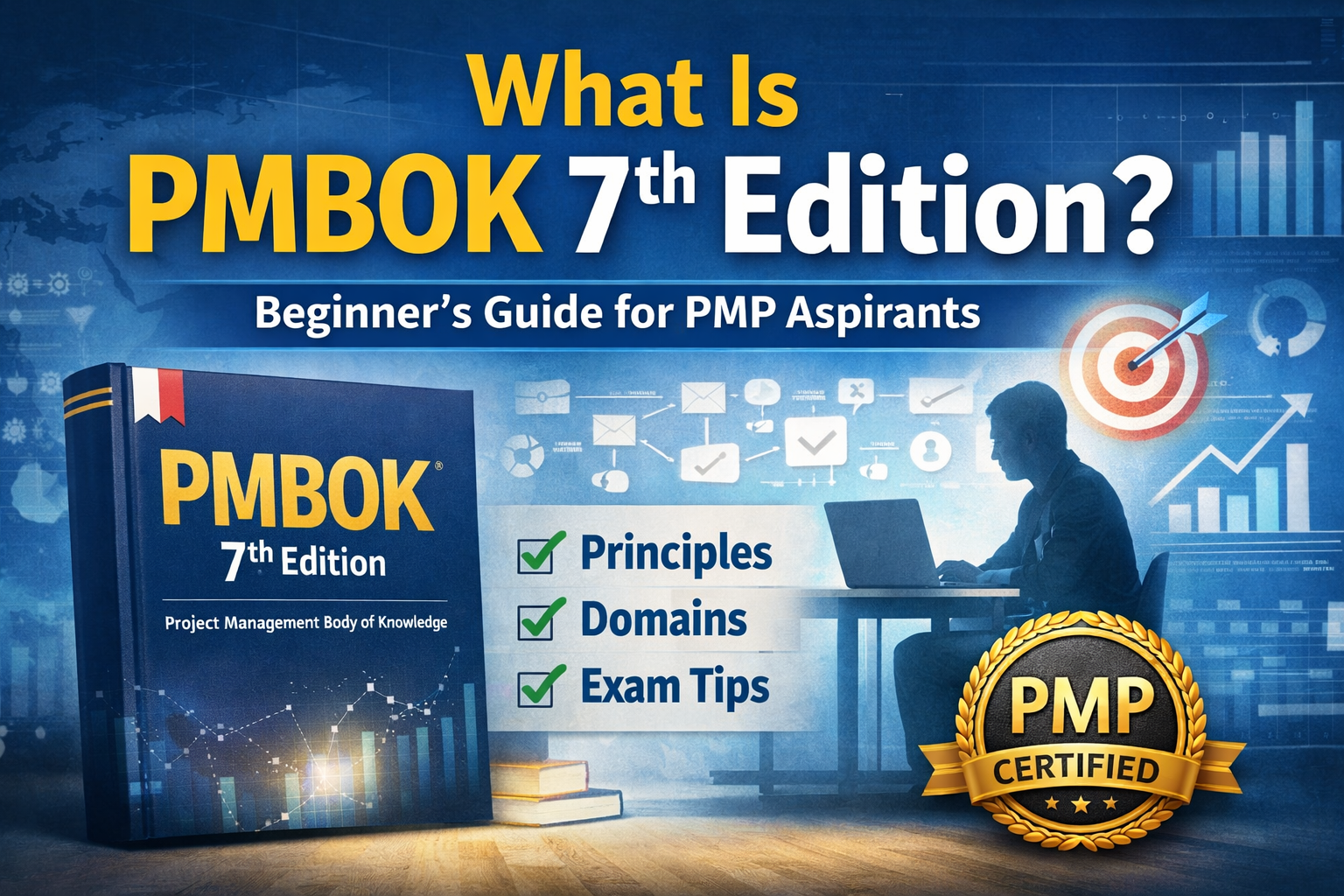
What Is PMBOK 7th Edition? Complete Beginner’s Guide for PMP Aspirants (2026 Updated Guide)
🚀 Introduction
If you are planning to crack the PMP certification or grow into a project management leadership role, one term you’ll hear repeatedly is PMBOK 7th Edition.
But here’s the reality:
Most beginners get confused because PMBOK 7 is completely different from previous editions.
Instead of processes and heavy frameworks, it focuses on principles, performance domains, and real-world adaptability.
So in this guide, we’ll break it down in simple, practical language—especially for professionals (including pharma professionals) who want to:
- Crack PMP exam
- Transition into project management roles
- Build leadership-level skills
Let’s dive in.
📘 What Is PMBOK 7th Edition?
The PMBOK 7th Edition (Project Management Body of Knowledge) is the latest standard published by PMI (Project Management Institute).
It acts as a modern guidebook for project management practices.
👉 Unlike older versions, PMBOK 7 focuses on:
- Principles over processes
- Outcomes over documentation
- Flexibility over rigid frameworks
🔍 Key Definition
PMBOK 7th Edition is a principle-based project management framework designed to guide professionals in delivering value across different industries.
⚡ Why PMBOK 7th Edition Matters for PMP Aspirants
If you’re preparing for PMP, understanding PMBOK 7th Edition is non-negotiable.
Here’s why:
🎯 Key Reasons
- PMP exam is aligned with modern project practices
- Focus on Agile + Hybrid approaches
- Emphasis on real-world scenarios
- Shift toward value delivery mindset
👉 According to industry trends, companies now prefer:
- Adaptive leaders
- Agile thinkers
- Problem-solvers (not just process followers)
🔄 PMBOK 7 vs PMBOK 6: What Changed?
This is where most confusion happens.
Let’s simplify it:
📊 Major Differences
| PMBOK 6th Edition | PMBOK 7th Edition |
|---|---|
| Process-based (49 processes) | Principle-based |
| 10 Knowledge Areas | 8 Performance Domains |
| Predictive approach | Agile + Hybrid + Predictive |
| Heavy documentation | Value-driven execution |
💡 Key Insight
👉 PMBOK 6 = “HOW to manage projects”
👉 PMBOK 7 = “WHY and WHAT matters in projects”
🧩 12 Principles of PMBOK 7th Edition
The heart of PMBOK 7th Edition lies in its 12 principles.
These principles guide decision-making across projects.
🔑 The 12 Principles (Simplified)
- Stewardship – Act responsibly
- Team – Build strong teams
- Stakeholders – Engage actively
- Value – Focus on outcomes
- Systems Thinking – Understand the big picture
- Leadership – Inspire & guide
- Tailoring – Customize approach
- Quality – Deliver excellence
- Complexity – Manage uncertainty
- Risk – Proactively handle risks
- Adaptability – Be flexible
- Change – Embrace transformation
🎯 Example (Real-Life)
In pharma projects (like facility setup or validation):
- You can’t rely only on fixed processes
- You must adapt to regulatory changes
👉 That’s exactly where PMBOK 7th Edition principles become powerful.
🏗️ 8 Performance Domains Explained
Instead of knowledge areas, PMBOK 7 introduces 8 performance domains.
These focus on outcomes rather than steps.
📌 The 8 Domains
- Stakeholder
- Team
- Development Approach & Life Cycle
- Planning
- Project Work
- Delivery
- Measurement
- Uncertainty
🧠 Simple Breakdown
- Stakeholder → Who matters
- Team → Who executes
- Planning → How you plan
- Delivery → What you deliver
- Measurement → How you track
💡 Pro Tip
👉 PMP exam questions are now scenario-based, not theory-based.
Understanding these domains is critical.
📊 How PMBOK 7th Edition Impacts PMP Exam
The PMP exam is no longer about memorizing processes.
🎯 New Exam Focus
- 50% Agile/Hybrid
- 50% Predictive + Business environment
- Scenario-based questions
🧠 What You Need to Do
Instead of memorizing:
❌ ITTOs (Inputs, Tools, Outputs)
✔ Focus on decision-making logic
🚀 Smart Strategy
- Learn principles deeply
- Practice real-world case studies
- Understand Agile mindset
🛠️ Practical Example (Pharma Industry)
Let’s make it relatable.
🏭 Scenario:
You are managing a sterile plant project
Challenges:
- Regulatory compliance
- Equipment delays
- Validation timelines
🔍 How PMBOK 7 Helps:
- Use risk principle → Identify delays early
- Use adaptability principle → Switch strategies
- Use stakeholder domain → Align QA, production, vendors
👉 This is why PMBOK 7 is industry-relevant, not theoretical.
🎯 How to Study PMBOK 7th Edition Effectively
Here’s a practical roadmap 👇
📚 Step-by-Step Study Plan
1. Start with Basics
- Understand principles
- Don’t memorize—understand
2. Combine with Agile
- Learn Scrum & Agile mindset
3. Practice Questions
- Focus on scenario-based MCQs
4. Use Real Examples
- Apply concepts to your work
⏱️ Ideal Timeline
- Working professionals → 6–8 weeks
- Full-time learners → 3–4 weeks
🚫 Common Mistakes to Avoid
Many PMP aspirants fail because of these:
❌ Mistakes
- Memorizing instead of understanding
- Ignoring Agile concepts
- Skipping mock tests
- Not practicing real scenarios
✅ Correct Approach
- Think like a project manager
- Focus on decision-making
- Practice consistently
📈 Career Benefits of Learning PMBOK 7th Edition
Mastering PMBOK 7th Edition can transform your career.
💼 Career Growth Opportunities
- Project Manager
- Program Manager
- Pharma Project Lead
- Operations Manager
💰 Salary Impact
- PMP-certified professionals earn 20–30% higher salaries
- Global demand for project managers is increasing
🚀 Especially for Pharma Professionals
As highlighted in the industry, pharma is evolving rapidly with:
- Digital transformation
- Regulatory complexity
- Skill gaps in project execution
👉 This makes project management skills + PMBOK 7 knowledge extremely valuable.
🎓 Why PMP Certification Is Still Worth It
Even with evolving frameworks, PMP remains gold standard.
🔥 Key Benefits
- Global recognition
- Leadership credibility
- Structured thinking
- Career switch opportunities
💡 Bonus Insight
Programs like:
👉 PMP Certification Training include:
- PMBOK 7 curriculum
- Mock exams
- Real-world case studies
- Mentorship support
❓ FAQ Section
❓ Is PMBOK 7th Edition enough for PMP exam?
No. It’s important but you also need:
- Agile guide
- Practice questions
- Mock tests
❓ Is PMBOK 7 easier than PMBOK 6?
Yes and no.
- Easier → Conceptual
- Harder → Requires understanding
❓ How many principles are in PMBOK 7?
There are 12 principles.
❓ Is PMBOK 7 fully Agile?
No.
It supports:
- Predictive
- Agile
- Hybrid
❓ How long does it take to learn PMBOK 7?
- 4–8 weeks depending on your schedule
🏁 Conclusion
The PMBOK 7th Edition is not just a guide—it’s a mindset shift.
It teaches you to:
- Think like a leader
- Deliver value
- Adapt to real-world challenges
If you’re serious about PMP certification and career growth, this is your foundation.
🚀 CTA (Call to Action)
If you want to crack PMP with real-world understanding (not just theory):
👉 Explore:
https://gauravdakshini.com/courses/pmp-certification-training/
Get access to:
- PMBOK 7-based training
- 1200+ practice questions
- Real-life pharma case studies
- Personalized mentoring
👉 Start your PMP journey today and build a future-proof career.
Your trusted partner for pharma skills, systems, and solutions.

