No products in the cart.
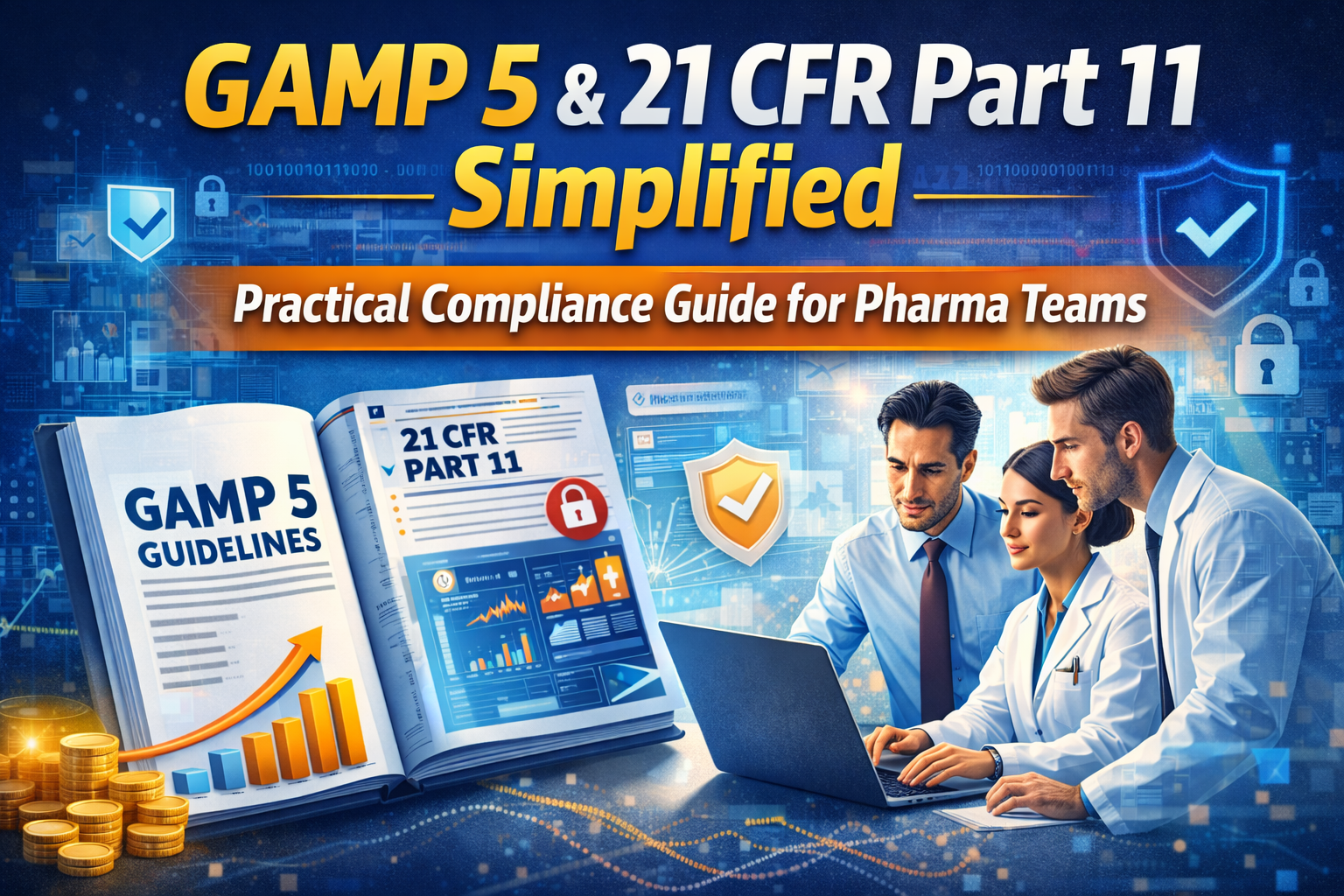
GAMP 5 & 21 CFR Part 11 Simplified: Practical Compliance Guide for Pharma Teams
Introduction: Why Pharma Teams Struggle with Compliance
If you’re working in the pharmaceutical industry, you’ve likely heard of GAMP 5 and 21 CFR Part 11.
Yet, despite their importance, most pharma professionals find them:
- Overly complex
- Highly technical
- Difficult to implement in real-world scenarios
The reality? These frameworks are not just regulatory requirements—they are business enablers.
With increasing digital transformation, data integrity concerns, and strict regulatory audits, understanding GAMP 5 and 21 CFR Part 11 is no longer optional—it’s a career-critical skill.
In this blog, we’ll simplify both frameworks, connect them to practical pharma operations, and show you how to implement them effectively.
What is GAMP 5? (Simplified)
Definition
GAMP 5 (Good Automated Manufacturing Practice) is a risk-based approach to validating computerized systems in pharma.
Core Objective
Ensure that systems:
- Are fit for intended use
- Maintain data integrity
- Comply with regulatory expectations
Why It Matters
In modern pharma:
- Everything is digitized (ERP, LIMS, MES, BMS)
- Data errors = compliance risks
- Audits demand system validation
GAMP 5 ensures your systems are:
✔ Reliable
✔ Traceable
✔ Audit-ready
Key Principles of GAMP 5
1. Risk-Based Approach
Not all systems require the same level of validation.
Example:
- Critical system (e.g., batch manufacturing) → High validation
- Supporting system (e.g., HR software) → Minimal validation
2. Lifecycle Approach
Validation is not a one-time activity.
It includes:
- Concept
- Project
- Operation
- Retirement
3. Scalable Validation
Effort depends on:
- System complexity
- Impact on product quality
- Patient safety
4. Supplier Involvement
Leverage vendor documentation to reduce validation effort.
What is 21 CFR Part 11? (Simplified)
Definition
21 CFR Part 11 is an FDA regulation governing:
- Electronic records
- Electronic signatures
Core Requirement
Ensure digital systems are:
- Secure
- Traceable
- Tamper-proof
Key Requirements of 21 CFR Part 11
1. Data Integrity (ALCOA+)
Data must be:
- Attributable
- Legible
- Contemporaneous
- Original
- Accurate
2. Audit Trails
Every action must be traceable:
- Who did it
- When it was done
- What was changed
3. User Access Control
- Unique user IDs
- Password security
- Role-based access
4. Electronic Signatures
Must be:
- Legally equivalent to handwritten signatures
- Linked to specific records
GAMP 5 and 21 CFR Part 11: How They Work Together
This is where most pharma professionals get confused.
Simple Explanation
- GAMP 5 = How to validate systems
- 21 CFR Part 11 = What compliance systems must achieve
Example
| Scenario | GAMP 5 Role | 21 CFR Part 11 Role |
|---|---|---|
| Implementing LIMS | Validate system lifecycle | Ensure audit trails & security |
| ERP system | Risk-based validation | Electronic records compliance |
| MES system | Functional testing | Data integrity enforcement |
👉 Together, they ensure systems are both validated AND compliant
Real-Life Example: Pharma Manufacturing System
Let’s say you’re implementing a Manufacturing Execution System (MES).
Using GAMP 5
- Define user requirements
- Perform risk assessment
- Validate system functions
- Document lifecycle
Using 21 CFR Part 11
- Enable audit trails
- Secure user access
- Validate electronic signatures
👉 Result: Fully compliant, audit-ready system
Common Mistakes Pharma Teams Make
❌ Over-documentation
Creating unnecessary paperwork instead of focusing on risk
❌ Ignoring data integrity
Thinking validation = compliance (it’s not)
❌ Lack of training
Teams don’t understand practical implementation
❌ Treating compliance as a checkbox
Instead of integrating it into operations
Practical Implementation Strategy
Here’s a step-by-step approach to applying GAMP 5 and 21 CFR Part 11:
Step 1: System Classification
Classify system based on:
- Impact
- Complexity
Step 2: Risk Assessment
Identify:
- Critical data points
- Compliance risks
Step 3: Define Requirements
- User Requirement Specification (URS)
- Functional specs
Step 4: Validation Planning
- IQ (Installation Qualification)
- OQ (Operational Qualification)
- PQ (Performance Qualification)
Step 5: Ensure Part 11 Compliance
- Audit trails
- Access control
- Data security
Step 6: Documentation & Training
- SOPs
- User training
- Audit readiness
Role of Digital Transformation in Compliance
Pharma is moving towards:
- AI/ML
- Automation
- Digital twins
This increases:
- Compliance complexity
- Data integrity risks
👉 Which makes GAMP 5 and 21 CFR Part 11 even more critical
Why Pharma Professionals Must Learn This Now
If you want to grow in pharma:
- QA
- Validation
- Engineering
- IT
👉 These frameworks are non-negotiable skills
Career Benefits
- Higher salary roles
- Audit-facing responsibilities
- Leadership opportunities
How to Master GAMP 5 and 21 CFR Part 11
Learning theory is not enough.
You need:
✔ Real-life case studies
✔ Practical validation examples
✔ Industry use cases
This is exactly what structured programs like:
👉 The Pharma Architect Masterclass offer
Based on real industry experience, the program covers:
- Advanced GAMP 5 implementation
- 21 CFR Part 11 practical scenarios
- Data integrity frameworks
- Digital transformation in pharma
As highlighted in the brochure , the training includes:
- 100+ real-life case studies
- Hands-on implementation
- Industry-relevant modules
FAQs
1. Is GAMP 5 mandatory?
No, but it is widely accepted as the industry standard for validation.
2. Who enforces 21 CFR Part 11?
The FDA (Food and Drug Administration).
3. Can small pharma companies ignore these regulations?
No. Compliance applies regardless of company size.
4. What is the biggest challenge in implementation?
Lack of practical knowledge and real-world experience.
5. Is validation a one-time activity?
No. It is a lifecycle process.
Conclusion: From Confusion to Compliance
Understanding GAMP 5 and 21 CFR Part 11 doesn’t have to be overwhelming.
When simplified:
- GAMP 5 = Validation framework
- 21 CFR Part 11 = Compliance requirement
Together, they help you:
✔ Build compliant systems
✔ Ensure data integrity
✔ Pass audits confidently
CTA: Upgrade Your Pharma Skills
If you want to:
- Master compliance
- Learn real-world implementation
- Future-proof your pharma career
👉 Explore the Pharma Architect Masterclass and start your transformation today.
Your trusted partner for pharma skills, systems, and solutions.

