No products in the cart.
Cleanroom HVAC & Energy Optimization: Reducing Pharma Facility Costs Without Compliance Risk
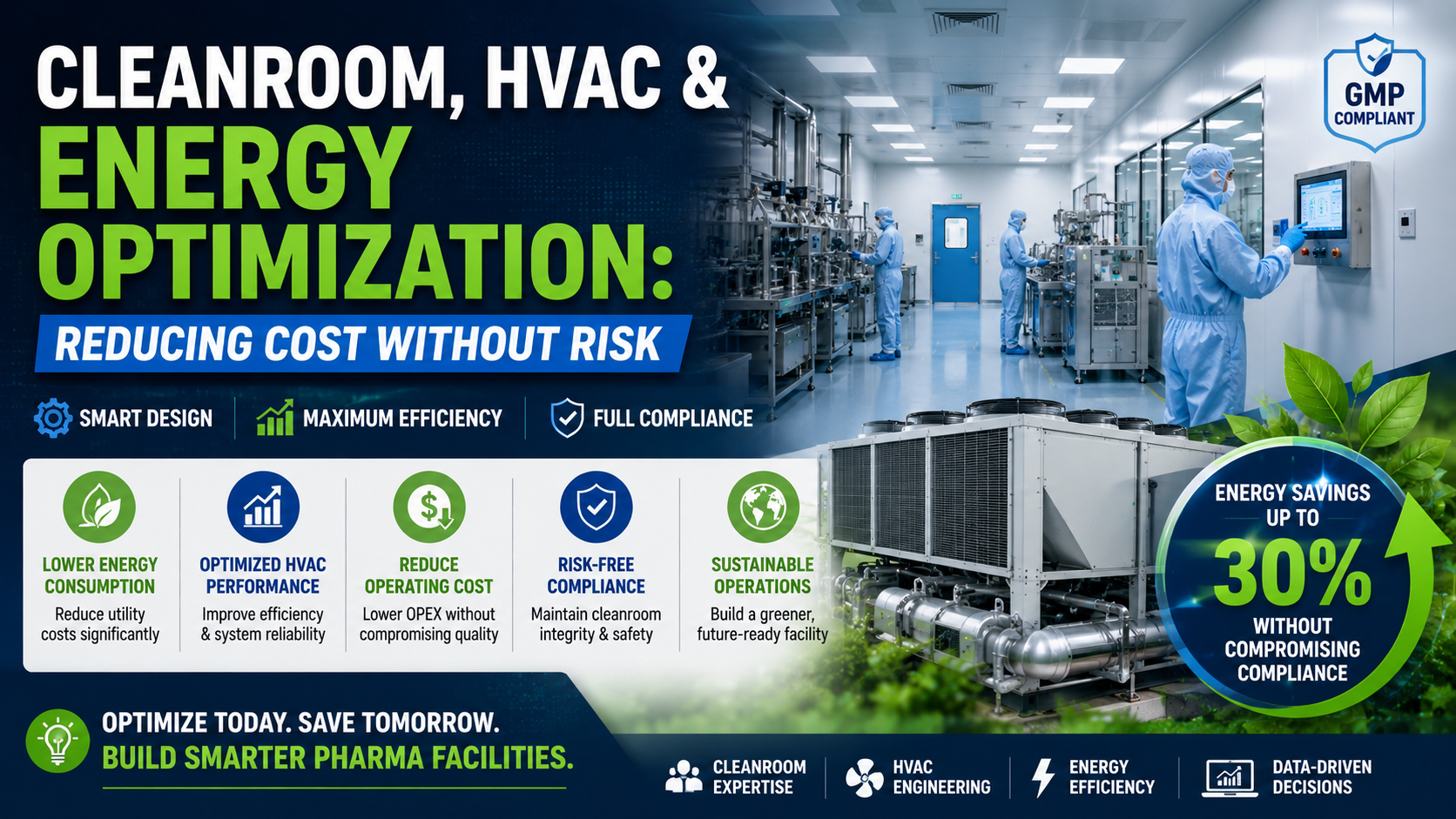
The pharmaceutical industry is under increasing pressure to reduce operational expenses while maintaining strict regulatory compliance. Among all utility systems in a pharmaceutical facility, HVAC systems consume one of the highest portions of operational energy. In sterile manufacturing environments and cleanrooms, HVAC systems can account for nearly 40–60% of total energy usage.
This is where Cleanroom HVAC & Energy Optimization becomes a game-changing strategy.
Most pharma companies assume that reducing energy consumption may compromise cleanroom compliance, airflow quality, pressure cascades, or product safety. However, modern engineering practices prove that energy optimization can be achieved without increasing regulatory risk.
The key lies in smart design, risk-based engineering, digital monitoring, and proper operational strategies.
In this blog, we will explore how pharmaceutical companies can reduce energy costs while maintaining GMP compliance, sterile assurance, and operational excellence.
We’ll also discuss practical insights from industry experts and how professionals can master these concepts through the The Pharma Architect Masterclass.
Why HVAC Systems Consume Massive Energy in Pharma Facilities
Pharmaceutical cleanrooms require highly controlled environments to maintain product quality and regulatory compliance.
These environments demand:
- Continuous air filtration
- High Air Changes Per Hour (ACH)
- Temperature and humidity control
- Differential pressure maintenance
- HEPA filtration
- Contamination control
- 24/7 operational stability
Because of these requirements, HVAC systems run continuously with high loads.
Major Energy Consumption Areas
1. High Air Change Rates
Sterile facilities often operate with 20–60 air changes per hour, significantly increasing fan energy consumption.
2. Humidity Control
Dehumidification and humidification systems consume massive energy, especially in tropical climates.
3. Overdesigned Systems
Many facilities use conservative HVAC designs that exceed actual process requirements.
4. Simultaneous Heating and Cooling
Improper controls often result in simultaneous heating and cooling, leading to unnecessary energy waste.
5. Poor Monitoring Systems
Lack of real-time analytics prevents identification of energy inefficiencies.
The Real Challenge: Cost Reduction Without Compliance Risk
The pharmaceutical sector cannot simply reduce airflow or turn off HVAC systems to save energy.
Every optimization must maintain compliance with:
- GMP guidelines
- EU Annex 1
- US FDA expectations
- ISO cleanroom standards
- Data integrity requirements
- Environmental monitoring expectations
This is why Cleanroom HVAC & Energy Optimization requires a scientific and risk-based approach.
Improper optimization can lead to:
- Cross contamination
- Pressure imbalance
- Regulatory observations
- Product rejection
- Failed media fills
- Increased microbial contamination
The goal is not just reducing energy costs.
The goal is intelligent optimization.
Key Strategies for Cleanroom HVAC & Energy Optimization
1. Optimize Air Change Rates Based on Risk
Many legacy facilities operate with excessively high ACH values.
Modern regulatory guidance supports risk-based airflow design rather than fixed traditional values.
Example:
A Grade C cleanroom operating at 35 ACH may function effectively at 20–25 ACH after proper airflow studies and particle monitoring validation.
Benefits:
- Reduced fan power consumption
- Lower cooling load
- Improved equipment lifespan
However, optimization must be validated through:
- Airflow visualization studies
- Particle count analysis
- Recovery studies
- Environmental monitoring data
2. Use Variable Frequency Drives (VFDs)
VFDs help control motor speed based on actual demand.
Instead of operating fans at full speed continuously, systems can dynamically adjust airflow requirements.
Applications:
- AHU fan motors
- Chilled water pumps
- Cooling tower fans
- Exhaust systems
Benefits:
- 20–40% energy reduction
- Reduced mechanical wear
- Improved operational flexibility
3. Implement Smart Building Management Systems (BMS)
Modern pharma facilities are moving toward data-driven operations.
A smart BMS can monitor:
- Differential pressure
- Temperature
- Humidity
- Energy consumption
- Filter loading
- Fan efficiency
With analytics dashboards, companies can identify hidden inefficiencies.
This is where Industry 4.0 technologies are transforming pharmaceutical engineering.
4. Optimize HEPA Filter Management
Clogged filters increase pressure drop, forcing fans to consume more energy.
Many facilities replace filters too early or too late.
Best Practices:
- Monitor differential pressure trends
- Replace filters based on performance data
- Use predictive maintenance analytics
Result:
- Reduced energy usage
- Better airflow consistency
- Lower maintenance costs
5. Improve Cleanroom Pressure Cascade Design
Incorrect pressure cascade design often causes excessive air leakage and unnecessary airflow demand.
Optimization Techniques:
- Proper door interlocking
- Controlled pressure differentials
- Leakage testing
- Air balancing
This significantly improves cleanroom energy efficiency without compromising contamination control.
Role of Digital Transformation in HVAC Optimization
Modern pharmaceutical engineering is no longer limited to mechanical systems.
Digital transformation is changing the industry through:
- AI-driven analytics
- Predictive maintenance
- Digital twins
- Real-time dashboards
- IoT-based monitoring
- Machine learning models
Companies are increasingly using Power BI and Tableau dashboards to monitor HVAC performance trends.
This allows engineering teams to:
- Predict failures
- Detect abnormal energy spikes
- Monitor cleanroom performance
- Improve decision-making
Professionals who understand both HVAC engineering and data analytics have a major competitive advantage today.
Energy Optimization Opportunities in Sterile Facilities
Sterile manufacturing facilities offer major optimization potential.
Areas with Highest Savings Potential
| Area | Optimization Opportunity |
|---|---|
| AHU Systems | Fan speed optimization |
| Chillers | Load balancing |
| Cleanroom Design | Risk-based airflow |
| Utilities | Heat recovery systems |
| Monitoring | Smart analytics |
| Facility Layout | Reduced pressure loss |
| Operations | Occupancy-based control |
HVAC Optimization and Regulatory Expectations
One common misconception is that regulators discourage energy-saving initiatives.
In reality, regulators support scientifically justified optimization approaches.
However, companies must demonstrate:
- Risk assessment
- Validation evidence
- Data-driven justification
- Change control management
- Continuous monitoring
Documentation is critical.
Every optimization project should include:
- Risk assessment
- Engineering rationale
- Validation protocol
- Monitoring strategy
- SOP updates
- Change management records
Common Mistakes Pharma Companies Make
1. Blind Cost Cutting
Reducing airflow without engineering evaluation can create contamination risks.
2. Ignoring Lifecycle Costs
Cheap HVAC components often increase long-term operational expenses.
3. Lack of Training
Engineering teams may not understand modern optimization techniques.
4. No Data Analytics
Without analytics, energy-saving decisions become guesswork.
5. Overdependence on Legacy Design
Older facilities often continue outdated engineering practices.
Industry 4.0 and the Future of Pharma HVAC Systems
The future of pharma engineering is moving toward:
- Autonomous cleanrooms
- AI-based HVAC control
- Predictive environmental monitoring
- Energy-efficient sterile facilities
- Digital twins for facility simulation
- Smart validation systems
Companies investing in these technologies will gain significant operational advantages.
This is why modern professionals must continuously upgrade their skills.
Why Pharma Professionals Must Upskill in HVAC & Facility Design
The pharmaceutical industry is rapidly evolving.
Traditional engineering knowledge alone is no longer enough.
Today’s pharma professionals need expertise in:
- Cleanroom design
- HVAC optimization
- Regulatory compliance
- Industry 4.0
- AI/ML applications
- Data analytics
- Project management
According to the Skillup to Scaleup initiative by Gaurav Dakshini, upskilling is essential for both career growth and industry transformation.
The program focuses on practical implementation, real-life case studies, and modern pharmaceutical engineering systems.
Learn Advanced HVAC & Facility Design Through The Pharma Architect Masterclass
The The Pharma Architect Masterclass is designed specifically for pharma and biopharma professionals who want to master modern engineering and digital transformation concepts.
The program covers:
- GMP HVAC systems
- Facility design
- Energy-saving opportunities
- Industry 4.0
- AI/ML use cases
- Power BI dashboards
- Regulatory compliance
- Airflow visualization
- Project management
According to the official brochure, the masterclass also includes practical workshops, case studies, and real-world implementation strategies.
This makes it highly valuable for:
- Pharma engineers
- Validation professionals
- Plant managers
- HVAC consultants
- Quality professionals
- Automation engineers
- Facility designers
Practical Example: Energy Optimization Without Compliance Risk
Let’s consider a hypothetical sterile injectable facility.
Problem:
The facility faced:
- High utility costs
- Excessive HVAC energy consumption
- Frequent HEPA replacements
Optimization Actions:
- Reduced unnecessary ACH levels
- Installed VFDs
- Improved pressure balancing
- Added energy analytics dashboards
- Optimized humidity control logic
Result:
- 28% reduction in HVAC energy costs
- Improved airflow stability
- Better environmental monitoring trends
- Reduced maintenance costs
Most importantly:
No GMP compliance issues occurred because all changes were risk-assessed and validated.
This demonstrates the true power of Cleanroom HVAC & Energy Optimization.
FAQ Section
What is Cleanroom HVAC & Energy Optimization?
It refers to strategies that improve HVAC efficiency in pharmaceutical cleanrooms while maintaining GMP compliance and contamination control.
Can energy savings affect cleanroom compliance?
Yes, if implemented incorrectly. However, risk-based optimization with proper validation can reduce energy costs safely.
How much energy can pharma facilities save?
Depending on facility design, companies can achieve 20–40% HVAC energy savings through optimization initiatives.
What technologies help in pharma HVAC optimization?
Key technologies include:
- BMS systems
- AI analytics
- IoT monitoring
- Predictive maintenance
- Digital twins
- Power BI dashboards
Why is HVAC important in pharmaceutical manufacturing?
HVAC systems maintain controlled environments necessary for:
- Product quality
- Sterility assurance
- Contamination control
- Regulatory compliance
How can professionals learn pharma HVAC optimization?
Professionals can learn through specialized industry-focused programs like the The Pharma Architect Masterclass.
Conclusion
The pharmaceutical industry is entering a new era where operational excellence, sustainability, and compliance must work together.
Companies can no longer afford inefficient HVAC systems that increase costs without adding value.
At the same time, regulatory compliance can never be compromised.
This is why Cleanroom HVAC & Energy Optimization has become one of the most important focus areas in modern pharmaceutical engineering.
Organizations that embrace:
- Smart facility design
- Data analytics
- Industry 4.0
- AI-driven monitoring
- Risk-based engineering
will achieve major competitive advantages in the coming years.
For professionals, this shift also creates enormous career opportunities.
By mastering cleanroom engineering, HVAC optimization, regulatory compliance, and digital transformation, pharma professionals can become future-ready leaders in the industry.
If you want to develop these advanced skills, explore the The Pharma Architect Masterclass and start your transformation journey today.
Your trusted partner for pharma skills, systems, and solutions.

