No products in the cart.
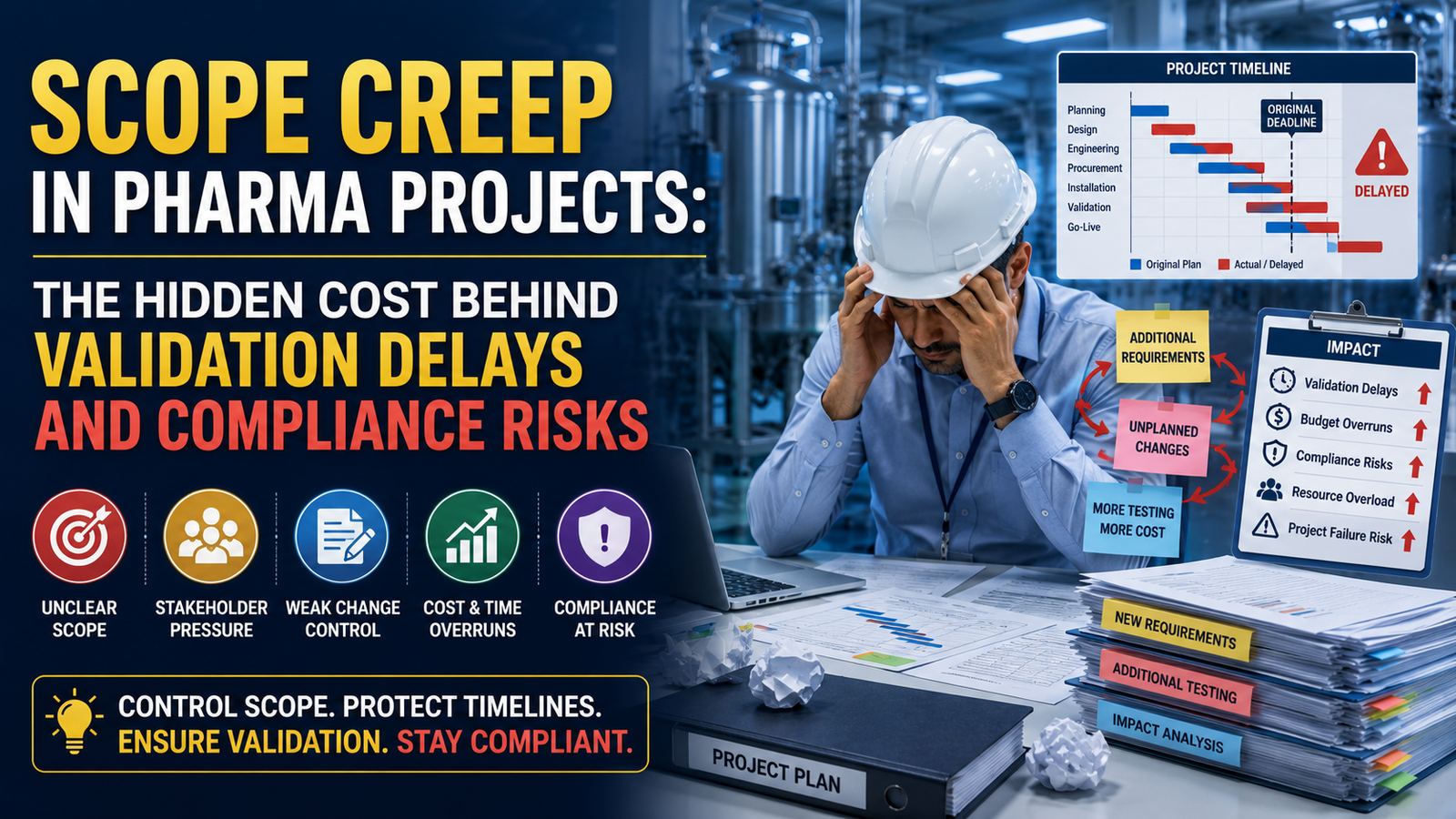
Scope Creep in Pharma Projects: The Hidden Cost Behind Validation Delays and Compliance Risks
Introduction
A pharmaceutical project rarely fails because of poor technical expertise.
More often, projects fail because of poor planning, uncontrolled changes, unclear stakeholder expectations, and weak project governance.
One of the biggest yet least discussed reasons behind pharma project delays is scope creep in pharma projects.
Whether it’s a facility expansion, equipment qualification, cleanroom upgrade, computer system validation (CSV), serialization implementation, automation project, or regulatory remediation initiative, small, uncontrolled changes can quietly snowball into major project setbacks.
A single additional user requirement.
A new compliance expectation.
A last-minute engineering modification.
An unplanned validation protocol.
Individually, each change may appear insignificant.
Collectively, they can delay project completion by weeks or even months while significantly increasing costs and compliance risks.
In highly regulated pharmaceutical environments, where timelines are directly linked to product launches, regulatory inspections, and patient safety, uncontrolled scope changes are not merely project management issues—they are business risks.
This article explores why scope creep in pharma projects occurs, how it impacts validation and compliance, and practical strategies to prevent it using proven project management principles.
What is Scope Creep?
Scope creep refers to the uncontrolled expansion of a project’s original objectives without corresponding adjustments to:
- Budget
- Timeline
- Resources
- Documentation
- Risk assessments
- Validation activities
Unlike planned scope changes that follow formal approval processes, scope creep usually happens gradually.
It often starts with seemingly harmless requests such as:
- “Can we add one more report?”
- “Let’s validate one additional scenario.”
- “We should include another production line.”
- “Can we modify the HMI design?”
- “Let’s integrate one more software module.”
Each request appears reasonable.
Together, they can derail an entire project.
Why Scope Creep is Common in Pharma Projects
Pharmaceutical projects involve multiple stakeholders, including:
- Engineering
- Production
- Quality Assurance
- Validation
- Automation
- IT
- Regulatory Affairs
- Procurement
- Vendors
- Consultants
Every stakeholder has legitimate expectations.
Without clear scope definition, projects become vulnerable to continuous additions.
Common causes include:
Incomplete User Requirements
Poorly defined User Requirement Specifications (URS) often result in additional requirements emerging during execution.
Regulatory Changes
Updated regulatory expectations may require additional testing or documentation.
Weak Change Control
Changes introduced without structured impact assessments quickly accumulate.
Poor Communication
Departments working independently may introduce conflicting requirements.
Stakeholder Pressure
Senior management or business teams may request additional features after project initiation.
Understanding the Hidden Cost of Scope Creep
Most organizations only notice direct expenses.
However, the real cost extends much further.
1. Validation Delays
Every new equipment modification, software enhancement, or process adjustment requires additional:
- IQ documentation
- OQ testing
- PQ execution
- Risk assessments
- Traceability updates
This dramatically increases validation effort.
Example:
A packaging line initially requiring 40 validation test cases may suddenly require 75 after multiple undocumented changes.
Validation timelines expand significantly.
2. Increased Compliance Risks
Regulatory agencies expect documented control over project changes.
Poorly managed scope changes may lead to:
- Missing approvals
- Incomplete traceability
- Documentation inconsistencies
- Change control deviations
- Audit observations
These issues can directly affect GMP compliance.
3. Budget Overruns
Additional scope usually requires:
- More engineering hours
- Vendor modifications
- Additional software licenses
- Extended validation
- Repeat testing
- Overtime
Projects that begin within budget frequently exceed estimates because the original scope was never protected.
4. Resource Overload
Teams become overloaded.
Validation engineers work weekends.
QA reviewers face documentation backlogs.
Automation teams continuously revise software.
Productivity declines while stress increases.
5. Delayed Product Launches
Perhaps the biggest business impact is delayed commercialization.
Every week of delay may result in:
- Lost revenue
- Delayed market entry
- Competitive disadvantage
- Inventory planning issues
Real-Life Example
Imagine a pharmaceutical company implementing a new automated visual inspection system.
Original Scope:
- Install equipment
- IQ/OQ/PQ
- Operator training
- SOP updates
Halfway through execution:
Production requests additional reject categories.
QA requests expanded audit trails.
IT requests ERP integration.
Engineering requests additional sensors.
Validation requests expanded protocol coverage.
Although each request appears justified, together they increase:
- Engineering work
- Software development
- Validation documentation
- Training
- FAT/SAT activities
The project originally planned for six months now requires nine months.
This is classic scope creep in pharma projects.
Scope Creep vs. Scope Change
These terms are often confused.
Scope Change
- Documented
- Approved
- Budget reviewed
- Timeline updated
- Risk assessed
Healthy projects accommodate controlled scope changes.
Scope Creep
- Informal
- Unapproved
- Gradual
- Poorly documented
- No impact assessment
The difference lies in governance—not in the change itself.
How Scope Creep Impacts Validation
Validation activities are particularly sensitive because every modification affects documentation.
Examples include:
Updated URS
Changes require:
- Design review
- Requirement traceability
- Protocol updates
Additional Functionalities
Need:
- New IQ checks
- Additional OQ testing
- Extended PQ scenarios
Software Modifications
Require:
- Regression testing
- CSV documentation
- Updated risk assessments
Validation effort often increases disproportionately compared to the actual engineering change.
Common Pharma Project Risks Associated with Scope Creep
Poor scope control contributes to several major pharma project risks, including:
Schedule Slippage
Unplanned activities delay critical milestones.
Cost Escalation
Budgets expand without corresponding approvals.
Quality Issues
Rushed validation increases errors.
Resource Conflicts
Multiple departments compete for limited expertise.
Regulatory Exposure
Documentation gaps become audit findings.
Team Burnout
Continuous changes reduce morale and productivity.
Best Practices to Prevent Scope Creep
1. Develop a Detailed Project Charter
Clearly define:
- Objectives
- Deliverables
- Success criteria
- Exclusions
- Stakeholders
Ambiguity is the first step toward scope creep.
2. Prepare a Comprehensive URS
A well-written User Requirement Specification minimizes future surprises.
Include:
- Functional requirements
- Compliance requirements
- Performance expectations
- Acceptance criteria
3. Create a Work Breakdown Structure (WBS)
Breaking work into smaller packages improves visibility.
Every deliverable should be traceable.
A detailed WBS helps identify unauthorized additions early.
4. Implement Formal Change Control
Every requested change should answer:
- Why is the change needed?
- What is the impact?
- What is the cost?
- What is the schedule impact?
- What are the validation implications?
No change should proceed without documented approval.
5. Perform Risk Assessments
Each change should include:
- GMP impact
- Validation impact
- Patient risk
- Business risk
This prevents unnecessary additions.
6. Conduct Regular Scope Reviews
Weekly project meetings should review:
- Open change requests
- Pending approvals
- Schedule impact
- Budget variance
Early detection prevents large problems later.
7. Improve Stakeholder Communication
Many scope issues arise because teams work independently.
Regular communication keeps everyone aligned on project priorities and approved deliverables.
The Role of Project Management in Preventing Scope Creep
Strong project managers protect project objectives while balancing stakeholder expectations.
Key responsibilities include:
- Scope management
- Schedule management
- Cost control
- Risk management
- Stakeholder engagement
- Communication planning
- Change management
Structured project management methodologies, such as those covered in PMP frameworks, provide practical tools for controlling scope and minimizing project risks.
Digital Tools That Help Control Scope
Modern pharma organizations increasingly use:
- Microsoft Project
- Primavera
- Jira
- Power BI dashboards
- Change Control Systems
- Electronic Document Management Systems
Real-time dashboards help project managers monitor:
- Scope changes
- Budget status
- Schedule performance
- Validation progress
- Resource utilization
Skills Every Pharma Professional Should Develop
Future project leaders should strengthen:
Technical Skills
- GMP
- Validation
- GAMP 5
- Data Integrity
Project Skills
- Work Breakdown Structure
- Critical Path Analysis
- Risk Registers
- Earned Value Management
- Change Control
Leadership Skills
- Communication
- Negotiation
- Stakeholder Management
- Decision Making
The Pharma Architect Master Class includes practical workshops on Project Management, PMP concepts, Power BI dashboards, GAMP 5, Regulatory Audits, Digital Transformation, and real-life pharmaceutical case studies that help professionals manage complex projects more effectively.
Frequently Asked Questions
What is scope creep in pharma projects?
Scope creep refers to uncontrolled expansion of project requirements without corresponding approval, budget adjustment, or schedule changes.
Why does scope creep delay validation?
Every project modification typically requires updated validation protocols, documentation, testing, risk assessments, and approvals, increasing the overall validation effort.
How can pharma project delays be minimized?
Define clear project scope, implement formal change control, maintain stakeholder alignment, monitor risks regularly, and review project progress using structured project management practices.
What are the biggest pharma project risks?
Common risks include scope creep, schedule delays, budget overruns, regulatory non-compliance, resource shortages, and poor stakeholder communication.
Is PMP useful for pharma project managers?
Yes. PMP methodologies provide structured approaches for scope management, scheduling, risk management, stakeholder engagement, and project governance, making them highly relevant for pharmaceutical projects.
Conclusion
In pharmaceutical projects, uncontrolled changes rarely appear dangerous at first. However, small additions can quickly accumulate into major delays, increased validation effort, compliance challenges, budget overruns, and operational inefficiencies.
Successfully managing scope creep in pharma projects requires more than technical expertise. It demands structured planning, disciplined change control, proactive risk management, and strong stakeholder communication.
Professionals who master these project management skills are better equipped to deliver projects on time, maintain regulatory compliance, and drive successful business outcomes.
If you’re looking to strengthen your expertise in project management, validation, digital transformation, Power BI, GAMP 5, AI/ML, and regulatory excellence, The Pharma Architect Master Class offers practical, industry-focused learning designed specifically for pharmaceutical professionals. It combines real-world case studies with hands-on tools to help you lead complex pharma projects with confidence.
Explore The Pharma Architect Master Class:
https://gauravdakshini.com/courses/the-pharma-architect-master-class/
Your trusted partner for pharma skills, systems, and solutions.

