No products in the cart.
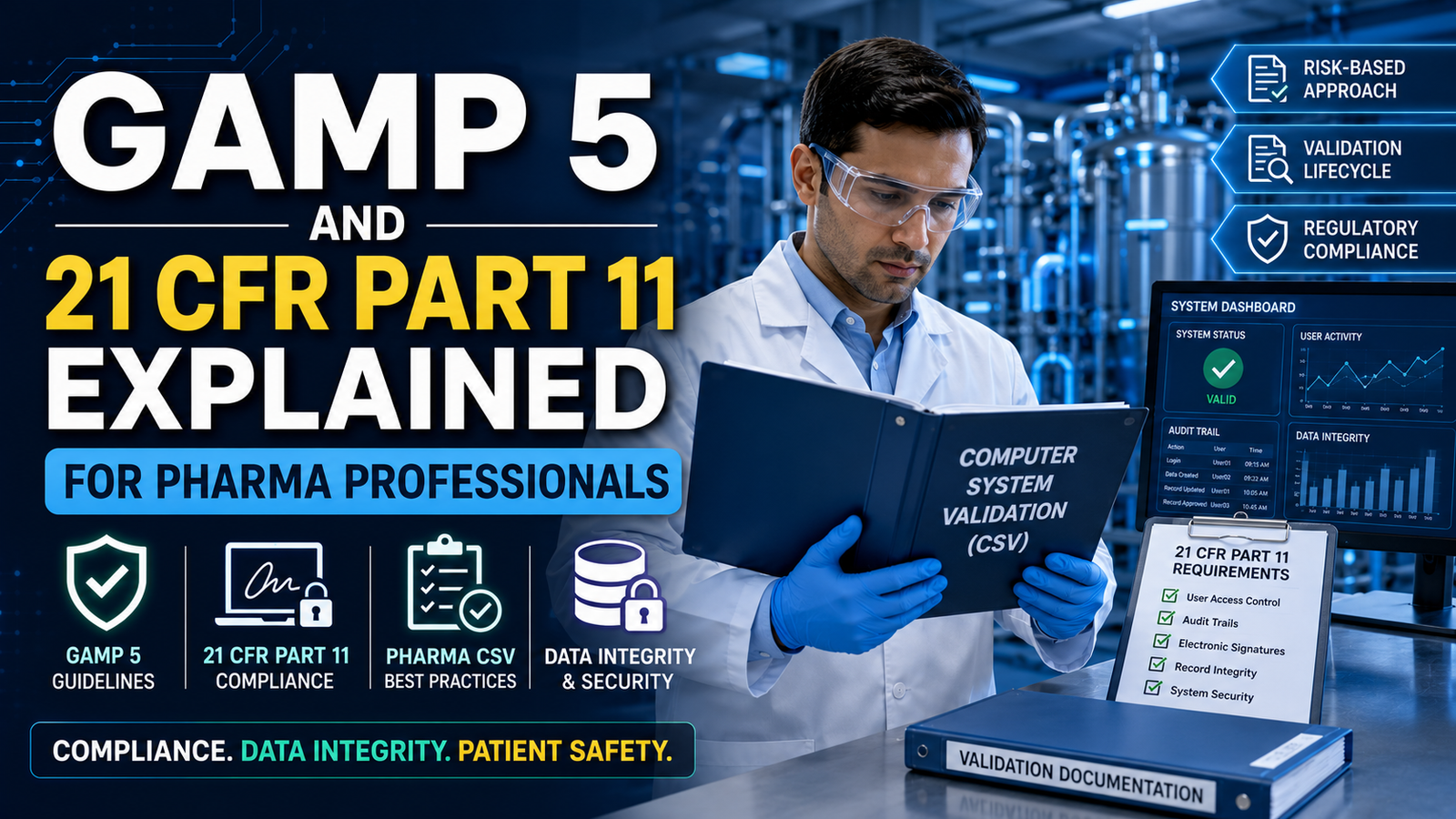
GAMP 5 Training Explained: A Complete Guide to 21 CFR Part 11 Compliance and Pharma CSV
Introduction
The pharmaceutical industry is becoming increasingly digital.
From Manufacturing Execution Systems (MES) and Laboratory Information Management Systems (LIMS) to Electronic Batch Records (EBR), SCADA systems, ERP platforms, Building Management Systems (BMS), and cloud-based quality applications, modern pharmaceutical companies rely heavily on computerized systems.
While these technologies improve productivity, they also introduce new regulatory responsibilities.
Regulators such as the US FDA, EMA, MHRA, and WHO expect pharmaceutical companies to ensure that computerized systems are reliable, secure, validated, and capable of maintaining data integrity throughout their lifecycle.
This is where GAMP 5 training, 21 CFR Part 11 compliance, and pharma CSV (Computer System Validation) become essential.
Unfortunately, many professionals hear these terms during audits or validation projects but struggle to understand how they fit together.
Are GAMP 5 and 21 CFR Part 11 the same?
What exactly is Computer System Validation?
Why do inspectors focus so much on electronic records and audit trails?
Most importantly, why are these skills becoming increasingly valuable for pharma professionals?
This comprehensive guide answers these questions while providing practical examples and actionable insights.
Why Computer System Validation Matters
Today’s pharmaceutical facilities use hundreds of computerized systems.
Examples include:
- Manufacturing Execution Systems (MES)
- Laboratory Information Management Systems (LIMS)
- Enterprise Resource Planning (ERP)
- SCADA
- PLC Systems
- Environmental Monitoring Systems
- Building Management Systems
- Quality Management Systems
- Document Management Systems
- Electronic Logbooks
If these systems fail, the consequences can include:
- Product quality issues
- Data integrity concerns
- Regulatory observations
- Batch rejection
- Production downtime
- Warning letters
Computer System Validation (CSV) ensures these systems consistently perform as intended while maintaining compliance throughout their lifecycle.
What is GAMP 5?
GAMP stands for Good Automated Manufacturing Practice.
GAMP 5 is a globally recognized framework developed by ISPE to help pharmaceutical companies validate computerized systems using a risk-based approach.
Unlike older validation methods that relied heavily on documentation, GAMP 5 focuses on:
- Product quality
- Patient safety
- Data integrity
- Efficient validation
- Risk management
- Lifecycle thinking
Modern GAMP 5 training teaches professionals how to validate systems effectively without creating unnecessary documentation.
Key Principles of GAMP 5
1. Product Quality First
Validation exists to ensure that computerized systems support consistent product quality.
Every validation activity ultimately protects the patient.
2. Lifecycle Approach
Validation does not begin during IQ or OQ.
It starts with planning and continues throughout the system lifecycle.
Typical lifecycle includes:
- Planning
- Requirements
- Design
- Development
- Testing
- Release
- Maintenance
- Retirement
3. Risk-Based Validation
Not every function carries equal risk.
Critical GMP functions receive greater validation effort than low-risk administrative functions.
This approach improves efficiency while maintaining compliance.
4. Leverage Supplier Activities
Instead of repeating vendor testing unnecessarily, organizations should leverage supplier documentation wherever appropriate.
This significantly reduces validation effort.
5. Continuous Improvement
Validation is not a one-time event.
Systems require ongoing:
- Change Control
- Incident Management
- Periodic Review
- Security Monitoring
- Backup Verification
Understanding 21 CFR Part 11 Compliance
One of the most misunderstood regulations in pharma is 21 CFR Part 11 compliance.
Simply put, it defines FDA requirements for:
- Electronic Records
- Electronic Signatures
The regulation ensures that electronic records are as trustworthy and reliable as traditional paper records.
It applies whenever GMP-regulated data is stored electronically.
Core Requirements of 21 CFR Part 11
Organizations must demonstrate:
User Access Control
Only authorized users can access systems.
Audit Trails
Every critical action should be automatically recorded.
Audit trails capture:
- Who performed the action
- What changed
- When it changed
- Why it changed (where applicable)
Electronic Signatures
Electronic signatures must be unique and legally equivalent to handwritten signatures.
Data Integrity
Records must remain:
- Accurate
- Complete
- Secure
- Available
- Traceable
System Validation
Computerized systems must be validated before operational use.
This directly connects Part 11 with pharma CSV.
What is Pharma CSV?
Computer System Validation (CSV) is the documented process of proving that computerized systems consistently perform according to their intended use.
CSV includes activities such as:
- User Requirement Specifications (URS)
- Functional Specifications
- Design Specifications
- Risk Assessments
- Installation Qualification (IQ)
- Operational Qualification (OQ)
- Performance Qualification (PQ)
- Traceability Matrix
- Validation Summary Report
This documentation demonstrates compliance during regulatory inspections.
Relationship Between GAMP 5, Part 11 and CSV
Many professionals confuse these concepts.
Think of them this way:
GAMP 5
Provides the validation methodology.
Pharma CSV
Is the actual validation process.
21 CFR Part 11
Defines regulatory requirements for electronic records and signatures.
Together they create a complete compliance framework.
Example: Validating a Laboratory Information Management System (LIMS)
Imagine a pharmaceutical company implementing a new LIMS.
The project includes:
- URS preparation
- Risk assessment
- Configuration
- Testing
- IQ
- OQ
- PQ
- User training
- SOP updates
GAMP 5 provides the methodology.
CSV executes the validation.
Part 11 ensures:
- Audit trails
- Electronic signatures
- User security
- Data integrity
All three work together.
Common Validation Documents
A typical validation package includes:
- Validation Plan
- User Requirement Specification
- Functional Specification
- Design Specification
- Configuration Specification
- Risk Assessment
- Traceability Matrix
- IQ Protocol
- OQ Protocol
- PQ Protocol
- Test Scripts
- Validation Summary Report
Understanding these documents is a critical outcome of GAMP 5 training.
Common Mistakes During CSV Projects
Many organizations make avoidable mistakes.
Incomplete URS
Poor requirements create validation gaps.
Weak Risk Assessment
Treating all functions equally wastes effort.
Missing Traceability
Every requirement should map to corresponding tests.
Poor Change Control
System updates without proper assessment create compliance risks.
Weak Audit Trail Review
Organizations often enable audit trails but fail to review them regularly.
Insufficient User Training
Even well-validated systems fail when users lack proper understanding.
Why These Skills Matter for Pharma Careers
As pharmaceutical companies accelerate digital transformation, demand is increasing for professionals with expertise in:
- Computer System Validation
- GAMP 5
- Data Integrity
- Digital Quality Systems
- Electronic Records
- Risk Management
- Regulatory Compliance
These skills are valuable for professionals working in:
- Validation
- QA
- QC
- Engineering
- Automation
- IT
- Manufacturing
- Regulatory Affairs
- Project Management
Career Benefits of Learning GAMP 5
Professionals with GAMP 5 training often enjoy:
Higher Employability
Validation expertise is in high demand.
Better Salary Potential
CSV specialists command competitive compensation.
Cross-Functional Opportunities
Validation knowledge supports engineering, QA, automation, and IT roles.
Leadership Development
Complex validation projects require strong project management and stakeholder coordination.
Future Trends in CSV
The future of computerized system validation includes:
- Cloud Validation
- AI-assisted Validation
- Continuous Validation
- Digital Validation Platforms
- Automated Testing
- Data Analytics
- Risk-Based Monitoring
Professionals who understand modern validation principles will be well positioned for Industry 4.0 initiatives.
How to Start Learning GAMP 5
A structured learning path includes:
Step 1
Understand GMP fundamentals.
Step 2
Learn validation lifecycle concepts.
Step 3
Study GAMP 5 methodology.
Step 4
Understand 21 CFR Part 11 requirements.
Step 5
Practice real CSV documentation.
Step 6
Work on practical validation case studies.
Training programs that combine GAMP 5, Project Management, Regulatory Audits, AI/ML, Digital Transformation, and real pharmaceutical case studies provide professionals with a comprehensive understanding of modern pharmaceutical systems. The Pharma Architect Master Class includes dedicated modules covering GAMP 5, 21 CFR Part 11, practical project management, regulatory compliance, and 100+ real-life case studies relevant to today’s pharma industry.
Frequently Asked Questions
What is GAMP 5?
GAMP 5 is an ISPE guideline that provides a risk-based framework for validating computerized systems used in regulated pharmaceutical environments.
Is GAMP 5 mandatory?
While GAMP 5 itself is guidance rather than regulation, it is widely accepted as the industry best practice for Computer System Validation.
What is 21 CFR Part 11?
21 CFR Part 11 is an FDA regulation governing electronic records and electronic signatures used in regulated industries.
What is Pharma CSV?
Computer System Validation (CSV) is the documented process of demonstrating that computerized systems consistently perform according to their intended use while meeting regulatory requirements.
Who should learn GAMP 5?
Validation Engineers, QA Professionals, Automation Engineers, IT Professionals, Manufacturing Engineers, Regulatory Affairs specialists, Project Managers, and anyone involved in GMP computerized systems.
Conclusion
As pharmaceutical manufacturing becomes increasingly digital, professionals must understand more than traditional GMP principles. Knowledge of GAMP 5 training, 21 CFR Part 11 compliance, and pharma CSV is now essential for ensuring reliable computerized systems, maintaining data integrity, and achieving regulatory compliance.
Organizations expect professionals who can confidently validate systems, manage electronic records, support digital transformation initiatives, and successfully navigate regulatory inspections. Developing expertise in these areas not only improves compliance but also creates significant career opportunities in validation, quality, automation, engineering, and project management.
If you’re ready to build future-ready skills, The Pharma Architect Master Class offers practical, industry-focused training covering GAMP 5, 21 CFR Part 11, Computer System Validation, Project Management, Power BI, AI/ML, Digital Transformation, Regulatory Audits, and real-world pharmaceutical case studies designed specifically for pharma professionals.
Your trusted partner for pharma skills, systems, and solutions.

