No products in the cart.
How to Prepare for Leadership Roles in Pharma Manufacturing: A Complete Career Roadmap
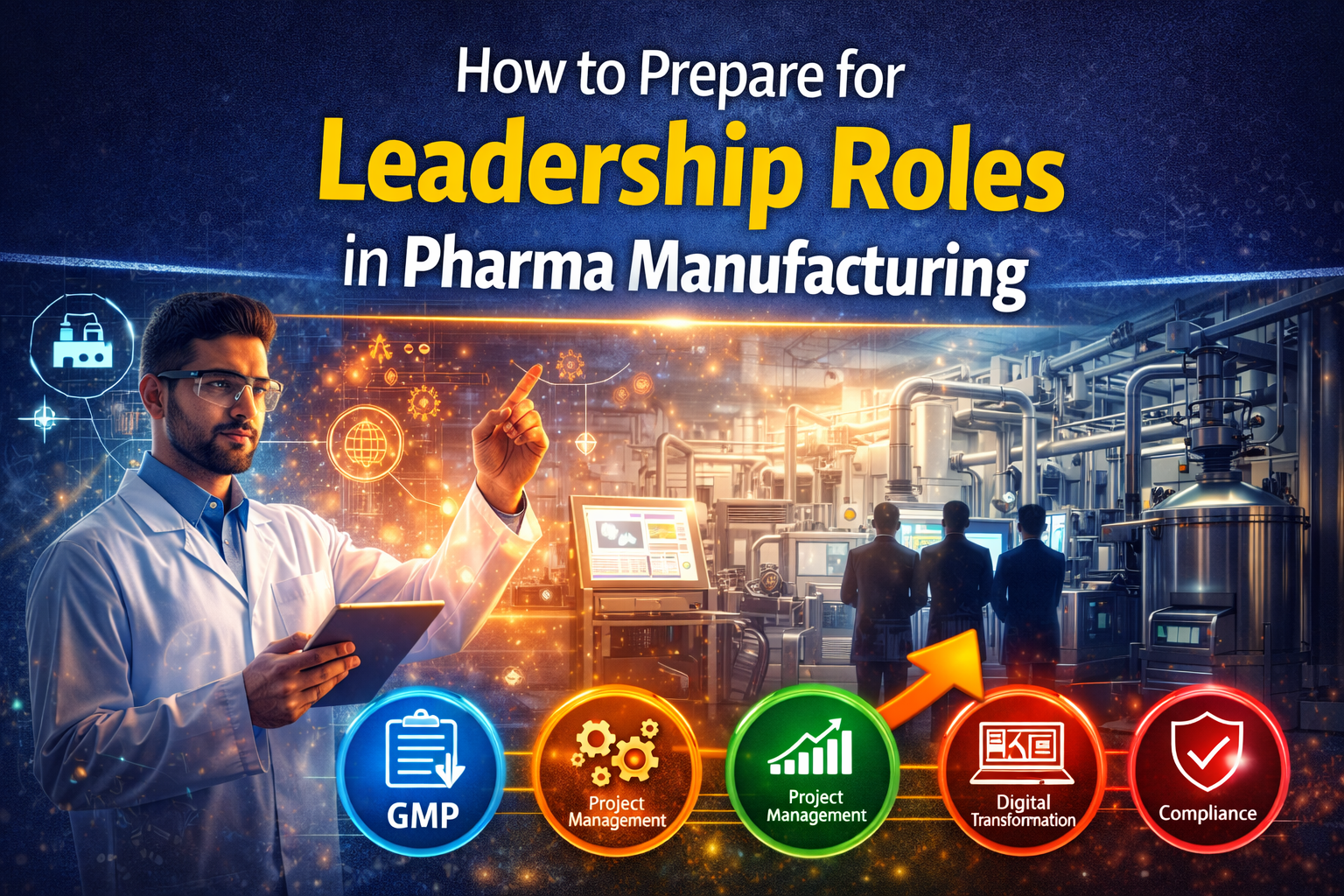
The pharmaceutical manufacturing industry is undergoing massive transformation.
Stricter regulations. Digitalization. Automation. AI-driven analytics. Increasing global audits. Higher compliance expectations.
Yet, most professionals in pharma plants remain in operational roles for years without clear leadership growth.
If you aspire to step into Leadership Roles in Pharma Manufacturing, you must prepare intentionally — not accidentally.
Leadership in pharma manufacturing is not awarded based on years of experience alone. It is earned through capability, vision, and structured development.
In this guide, you will learn:
- What pharma manufacturing leaders are really responsible for
- The essential skills required
- A step-by-step leadership preparation roadmap
- Common mistakes professionals make
- How to accelerate your growth strategically
Let’s begin.
Why Leadership Roles in Pharma Manufacturing Are More Demanding Than Ever
Earlier, plant leadership focused primarily on production targets and basic compliance.
Today, leaders must manage:
- Regulatory inspections (USFDA, MHRA, EU GMP)
- Data integrity risks
- Digital transformation initiatives
- Cross-functional global coordination
- Cost optimization without compliance compromise
- Automation and Industry 4.0 implementation
Modern Leadership Roles in Pharma Manufacturing require a combination of technical mastery, regulatory expertise, project management capability, and business acumen.
This is why many technically strong engineers struggle to move up.
What Do Leaders in Pharma Manufacturing Actually Do?
Before preparing for leadership, you must understand the responsibilities.
Pharma manufacturing leaders typically oversee:
- End-to-end production operations
- Quality compliance strategy
- Deviation and CAPA closure
- Resource planning
- Project execution (greenfield/brownfield)
- Audit readiness
- Continuous improvement initiatives
- Risk management
They do not just solve technical issues.
They make strategic decisions.
The 6-Step Roadmap to Prepare for Leadership Roles in Pharma Manufacturing
Let’s break this into practical stages.
Step 1: Strengthen Your Technical Foundation
Leadership begins with credibility.
Without strong technical depth, teams will not trust your decisions.
Focus on mastering:
- GMP regulations (21 CFR Part 211, EU Annex 1)
- Sterile and non-sterile manufacturing processes
- HVAC system design and monitoring
- Cleanroom classifications
- Process validation lifecycle
- Root cause analysis and CAPA
- Documentation practices aligned with data integrity
Action Tip:
Volunteer to lead deviation investigations and present findings in management meetings.
Step 2: Master Regulatory & Audit Readiness
Every pharma manufacturing leader must confidently handle audits.
Preparation includes:
- Understanding inspection expectations
- Anticipating common audit questions
- Managing documentation retrieval systems
- Closing CAPAs strategically
- Maintaining inspection-ready culture
Ask yourself:
If regulators visit tomorrow, can you confidently defend your department?
If not, you need upgrade exposure.
Step 3: Develop Strong Project Management Skills
Pharma plants constantly run projects:
- Facility expansion
- Equipment qualification
- Automation upgrades
- Digital transformation
- Process optimization
To prepare for Leadership Roles in Pharma Manufacturing, you must master:
- Project Charter preparation
- WBS (Work Breakdown Structure)
- Critical Path Method
- Cost control (CPI & SPI)
- Risk Register creation
- Stakeholder engagement
Leaders manage scope, schedule, cost, and risk — not just operations.
Practical Example:
An engineer monitors equipment performance.
A leader:
- Plans CAPEX budget
- Negotiates vendor contracts
- Tracks cost variance
- Aligns implementation with compliance deadlines
That difference defines leadership readiness.
Step 4: Upgrade Digital & Industry 4.0 Skills
Industry 4.0 is reshaping pharma manufacturing.
Future-ready leaders must understand:
- Power BI dashboards
- Tableau visualization
- AI/ML basics
- Predictive maintenance
- Digital Twin simulation
- MES integration
- Data integrity systems
Digital maturity is now essential for Leadership Roles in Pharma Manufacturing.
Leaders interpret data to drive decisions.
They do not rely on manual reporting.
Step 5: Build Financial & Business Awareness
Manufacturing leadership is not only about compliance.
It is also about business sustainability.
You must understand:
- Cost of quality
- OEE (Overall Equipment Effectiveness)
- Budget planning
- Operational efficiency
- Waste reduction
- ROI of automation
Example:
An engineer sees equipment downtime.
A leader sees:
- Production loss
- Compliance risk
- Revenue impact
- Customer delay penalties
Business thinking differentiates managers from leaders.
Step 6: Develop Leadership & Communication Skills
Technical expertise alone is insufficient.
You must build:
Communication Skills
- Present technical issues to senior management
- Handle conflict resolution
- Conduct cross-functional meetings
Team Leadership
- Mentor junior engineers
- Manage performance
- Build accountability culture
Decision-Making Ability
- Evaluate risk under pressure
- Prioritize critical issues
- Balance compliance and productivity
Strong communication accelerates leadership progression.
Common Mistakes Professionals Make
If you want Leadership Roles in Pharma Manufacturing, avoid these mistakes:
- Waiting for promotion before preparing
- Avoiding audit exposure
- Ignoring digital transformation
- Staying only in technical silo
- Not learning financial fundamentals
- Avoiding cross-functional collaboration
Leadership readiness must be built early.
Real-Life Career Progression Example
Consider two professionals with 10 years of pharma experience.
Professional A:
- Technically strong
- Handles routine operations
- Limited project ownership
- No digital skills
- Minimal audit exposure
Professional B:
- Leads cross-functional projects
- Builds dashboards
- Handles regulatory discussions
- Understands risk and cost impact
- Presents to leadership
Within 3–5 years, Professional B is promoted to:
- Manufacturing Head
- Operations Lead
- Compliance Lead
- Plant Manager
That is how preparation transforms career trajectory.
How Structured Learning Accelerates Leadership Growth
Random learning slows growth.
Structured upskilling accelerates it.
Programs like The Pharma Architect Masterclass combine:
- Project management mastery
- Industry 4.0 & Digital Transformation
- AI/ML use cases in pharma
- GAMP 5 & 21 CFR Part 11
- CGMP & Facility Design
- Regulatory audit workshops
- 100+ real-life case studies
Such structured development significantly shortens the timeline to secure Leadership Roles in Pharma Manufacturing.
Frequently Asked Questions
How long does it take to prepare for leadership roles in pharma manufacturing?
With focused effort and structured development, professionals can prepare within 2–4 years depending on exposure and commitment.
Do I need project management certification?
Project management knowledge is highly recommended because manufacturing leadership is project-driven.
Is digital skill necessary for pharma leaders?
Yes. Industry 4.0 and data-driven manufacturing are now standard expectations.
What is the fastest way to grow into pharma leadership?
Combine:
- Technical mastery
- Regulatory expertise
- Project management
- Digital analytics
- Business understanding
Final Thoughts: Leadership Is Prepared, Not Assigned
The pharma industry rewards those who prepare before opportunity arrives.
If you want Leadership Roles in Pharma Manufacturing, you must:
- Think beyond execution
- Develop cross-functional exposure
- Upgrade digital and project skills
- Strengthen audit readiness
- Build strategic thinking
Leadership is not a job title.
It is capability, visibility, and influence.
If you are serious about accelerating your journey into pharma manufacturing leadership, explore structured career development through The Pharma Architect Masterclass and start building the skills that matter most in today’s evolving pharma ecosystem.
Your trusted partner for pharma skills, systems, and solutions.

