No products in the cart.
AI in Pharma: 12 Real-World Machine Learning Applications Transforming the Pharmaceutical Industry in 2026
Introduction
Artificial Intelligence (AI) is no longer a futuristic concept in pharmaceuticals—it has become an operational necessity. From accelerating drug discovery to predicting equipment failures and ensuring regulatory compliance, AI in pharma is redefining how pharmaceutical companies operate.
According to recent industry estimates, the global AI healthcare market is expected to exceed $180 billion by 2030, with pharmaceutical companies investing heavily in AI-driven manufacturing, quality assurance, regulatory intelligence, and predictive analytics.
For pharma professionals, this presents both an opportunity and a challenge.
The opportunity lies in becoming indispensable by mastering AI-powered technologies. The challenge is that professionals who ignore digital transformation may struggle to remain competitive in the coming years.
This article explores the most impactful applications of AI in pharma, explains how the machine learning pharmaceutical industry is evolving, and highlights the skills every pharma professional should develop to stay ahead.
Why AI is Becoming Essential in Pharma
The pharmaceutical industry has traditionally relied on documentation, manual reviews, historical data, and standardized processes.
Today, companies are dealing with:
- Increasing regulatory expectations
- Massive production data
- Complex manufacturing operations
- Rising quality requirements
- Cost optimization initiatives
- Faster product development cycles
Traditional methods cannot efficiently process millions of data points generated daily.
This is where Artificial Intelligence changes everything.
AI systems continuously learn from operational data, identify hidden patterns, predict failures, and recommend corrective actions before problems occur.
Instead of reactive operations, pharmaceutical companies are moving toward predictive and intelligent manufacturing.
What is AI and Machine Learning?
Artificial Intelligence refers to computer systems capable of performing tasks that typically require human intelligence.
Machine Learning is a branch of AI where algorithms improve automatically by learning from historical data.
Simply put:
Traditional Software
Input → Rules → Output
Machine Learning
Input → Data → Learning → Prediction
This capability makes the machine learning pharmaceutical industry one of the fastest-growing technology sectors globally.
Why Pharma Professionals Should Learn AI
AI is no longer limited to IT teams.
Today’s pharma professionals increasingly work with:
- Power BI dashboards
- MES systems
- SCADA
- Manufacturing analytics
- Electronic Batch Records
- Predictive maintenance tools
- Statistical process control
- Digital Twins
Understanding AI enables professionals to:
- Make data-driven decisions
- Improve operational efficiency
- Reduce deviations
- Enhance compliance
- Build leadership skills
- Increase career opportunities
12 Real-World AI Applications in Pharma
1. AI in Drug Discovery
Drug development traditionally takes over a decade and billions of dollars.
AI dramatically reduces this timeline by:
- Identifying potential drug molecules
- Predicting protein interactions
- Screening millions of compounds
- Prioritizing clinical candidates
Machine learning models analyze biological datasets much faster than traditional laboratory methods.
Benefits include:
- Faster R&D
- Lower development cost
- Higher success probability
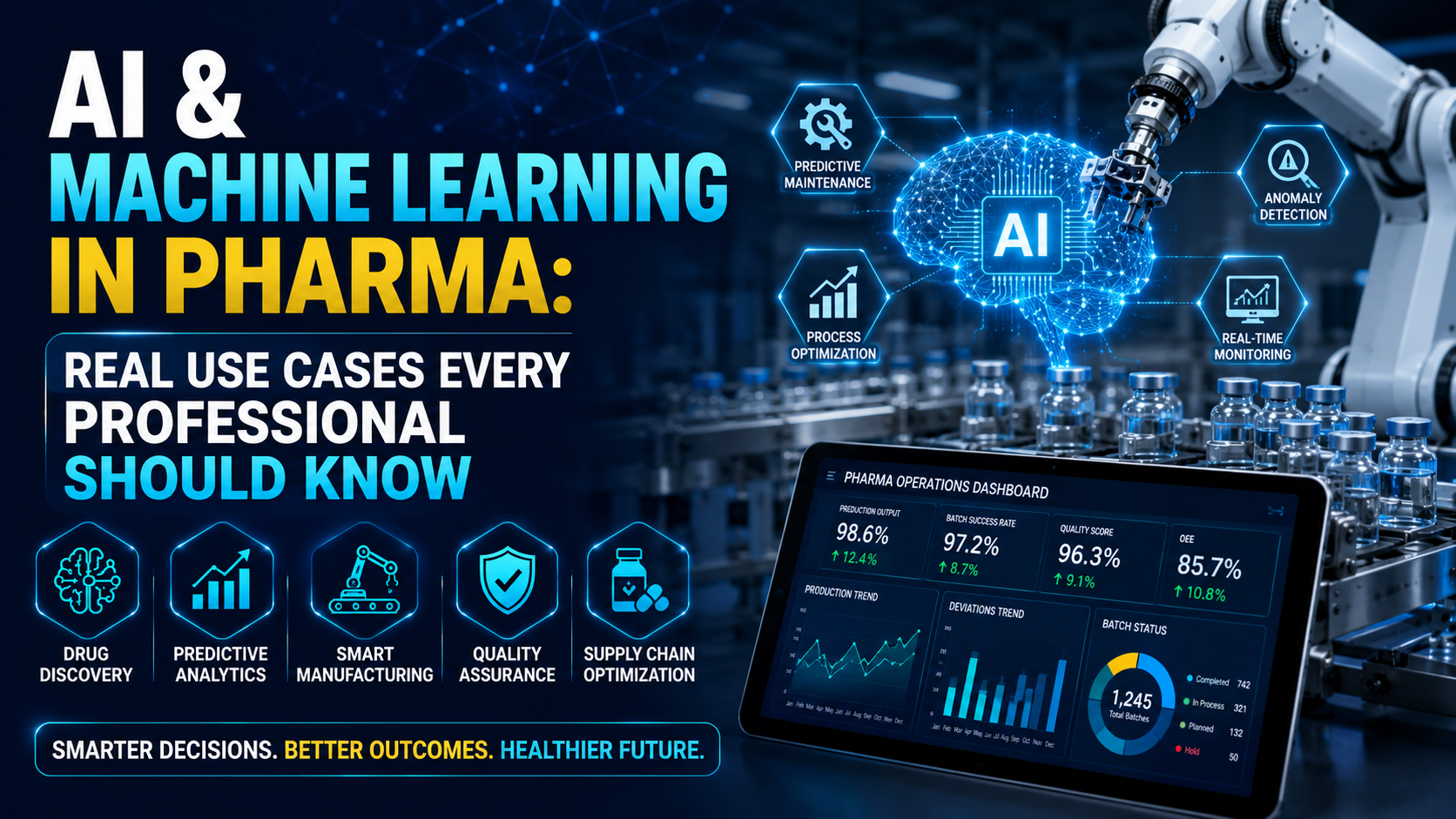
2. Predictive Maintenance in Manufacturing
Equipment failures are expensive.
Using AI sensors, pharmaceutical manufacturers continuously monitor:
- Motor vibration
- Temperature
- Pressure
- Energy consumption
- Machine runtime
Machine learning predicts failures before breakdowns occur.
Example:
Instead of replacing a pump every six months, AI recommends replacement only when performance indicators suggest wear.
Benefits:
- Reduced downtime
- Lower maintenance costs
- Improved Overall Equipment Effectiveness (OEE)
3. AI-Powered Visual Inspection
Visual inspection is one of the most critical quality processes in sterile manufacturing.
Modern AI cameras detect:
- Glass particles
- Fibers
- Cracks
- Cosmetic defects
- Fill volume variations
- Stopper defects
Deep learning algorithms continuously improve inspection accuracy.
Companies are increasingly integrating AI with visual inspection systems to improve defect detection while reducing false rejects. Advanced visual inspection training, Knapp Kits, and inspection solutions are becoming increasingly important in modern pharmaceutical quality systems.
4. Intelligent Batch Monitoring
Batch failures often result from small process variations.
AI continuously analyzes:
- Temperature trends
- Mixing profiles
- Pressure
- pH
- Flow rates
If abnormal behavior is detected, the system immediately alerts operators.
Benefits include:
- Reduced deviations
- Improved batch consistency
- Higher First Pass Yield
5. Predictive Quality Analytics
Quality departments generate enormous datasets.
AI identifies:
- Root causes of deviations
- CAPA effectiveness
- Out-of-trend results
- Process variability
- Future quality risks
Instead of reviewing historical reports, quality teams receive predictive recommendations.
6. AI for Regulatory Compliance
Documentation consumes significant effort.
AI assists by:
- Reviewing SOPs
- Comparing regulatory guidelines
- Detecting missing information
- Summarizing audit observations
- Tracking CAPAs
Rather than replacing QA professionals, AI improves their productivity.
7. Supply Chain Optimization
Pharmaceutical supply chains are highly sensitive.
Machine learning predicts:
- Inventory shortages
- Supplier delays
- Demand fluctuations
- Cold-chain risks
Benefits:
- Reduced stockouts
- Better planning
- Improved customer satisfaction
8. Process Optimization
Thousands of process parameters influence manufacturing.
AI analyzes:
- Mixing speed
- Temperature
- Compression force
- Coating parameters
- Granulation moisture
The system identifies the combination producing the highest quality with minimal waste.
9. AI-Based Energy Management
Pharma plants consume enormous energy.
Machine learning monitors:
- HVAC
- Compressed air
- Boilers
- Chillers
- Utilities
AI recommends:
- Optimal scheduling
- Load balancing
- Energy reduction opportunities
Lower energy consumption directly improves profitability.
10. Digital Twins
A Digital Twin is a virtual replica of equipment or manufacturing processes.
Instead of experimenting on production equipment, engineers simulate:
- Process changes
- Equipment modifications
- Capacity increases
- New product introductions
Many modern Industry 4.0 initiatives now combine AI with Digital Twins to reduce implementation risk.
11. AI in Clinical Trials
Clinical trials generate millions of records.
AI helps by:
- Selecting suitable patients
- Predicting trial outcomes
- Detecting safety signals
- Improving recruitment
Benefits:
- Faster studies
- Reduced costs
- Better patient outcomes
12. Intelligent Business Dashboards
Modern pharma companies rely on live dashboards instead of spreadsheets.
Power BI combined with AI provides:
- Production KPIs
- OEE
- Batch trends
- Quality metrics
- Deviation analysis
- Audit readiness
- Executive dashboards
Professionals capable of building these dashboards are increasingly valuable.
Skills Pharma Professionals Should Learn
To remain competitive, professionals should focus on:
Technical Skills
- AI fundamentals
- Machine Learning basics
- Power BI
- Tableau
- Python fundamentals
- Data Analytics
- Statistical Analysis
- Industry 4.0
Pharma Skills
- GMP
- Data Integrity
- Validation
- Risk Management
- Project Management
- HVAC
- Facility Design
- Regulatory Compliance
Training programs focused on AI/ML, Power BI, digital transformation, and practical pharma case studies are becoming increasingly valuable for professionals preparing for Industry 4.0 careers.
Benefits of AI for Pharmaceutical Companies
Organizations implementing AI in pharma are seeing measurable improvements:
- Faster manufacturing
- Better compliance
- Reduced deviations
- Improved product quality
- Lower operational costs
- Higher equipment availability
- Better decision-making
- Reduced manual effort
- Faster investigations
- Improved customer satisfaction
Common Challenges While Implementing AI
Despite the advantages, companies face several hurdles:
Data Quality
Poor-quality data leads to inaccurate predictions.
Employee Resistance
Teams may hesitate to adopt AI without proper training.
Regulatory Expectations
AI implementations must comply with GMP and data integrity principles.
Skill Gap
Many organizations lack professionals with expertise in both pharma and analytics.
The Future of AI in Pharma
Over the next five years, AI will expand into:
- Autonomous manufacturing
- Intelligent robotics
- Generative AI for documentation
- Real-time release testing
- Personalized medicine
- Smart regulatory submissions
- AI-assisted investigations
- Predictive validation
- Self-optimizing production systems
Professionals who embrace these technologies today will be well positioned to lead tomorrow’s pharmaceutical operations.
Frequently Asked Questions (FAQs)
Is AI replacing pharma professionals?
No. AI automates repetitive tasks and supports better decision-making, but skilled professionals remain essential for interpreting results, ensuring compliance, and driving continuous improvement.
What is the difference between AI and Machine Learning?
AI is the broader field of creating intelligent systems, while Machine Learning is a subset of AI where algorithms learn from historical data to make predictions.
Which pharma departments use AI the most?
AI is increasingly used across R&D, manufacturing, quality assurance, quality control, engineering, maintenance, regulatory affairs, supply chain, and business analytics.
Is coding mandatory to learn AI in pharma?
Not always. Many professionals begin with tools like Power BI and low-code AI platforms before progressing to Python or advanced machine learning.
Which skills should I learn first?
A practical roadmap includes:
- Power BI
- Pharma Data Analytics
- AI fundamentals
- Machine Learning basics
- GMP and Data Integrity
- Industry 4.0 concepts
- Project Management
Conclusion
Artificial Intelligence is transforming every stage of pharmaceutical operations—from drug discovery and manufacturing to quality assurance, compliance, maintenance, and executive decision-making.
The organizations that succeed in the coming decade will be those that combine deep pharmaceutical expertise with digital capabilities. Likewise, professionals who invest in AI in pharma, understand the machine learning pharmaceutical industry, and embrace pharma automation will be better equipped to solve complex challenges, improve operational excellence, and accelerate their careers.
Call to Action
If you’re ready to future-proof your career, now is the time to build expertise in AI, data analytics, Power BI, Industry 4.0, and modern pharmaceutical systems. Structured learning with practical case studies and real-world implementation can help you bridge the gap between traditional pharma operations and digital transformation.
Explore The Pharma Architect Masterclass to gain hands-on knowledge in AI/ML, Power BI, Project Management, Digital Transformation, GAMP 5, CGMP, HVAC, and other high-demand pharma skills designed for today’s industry.
Your trusted partner for pharma skills, systems, and solutions.

