No products in the cart.
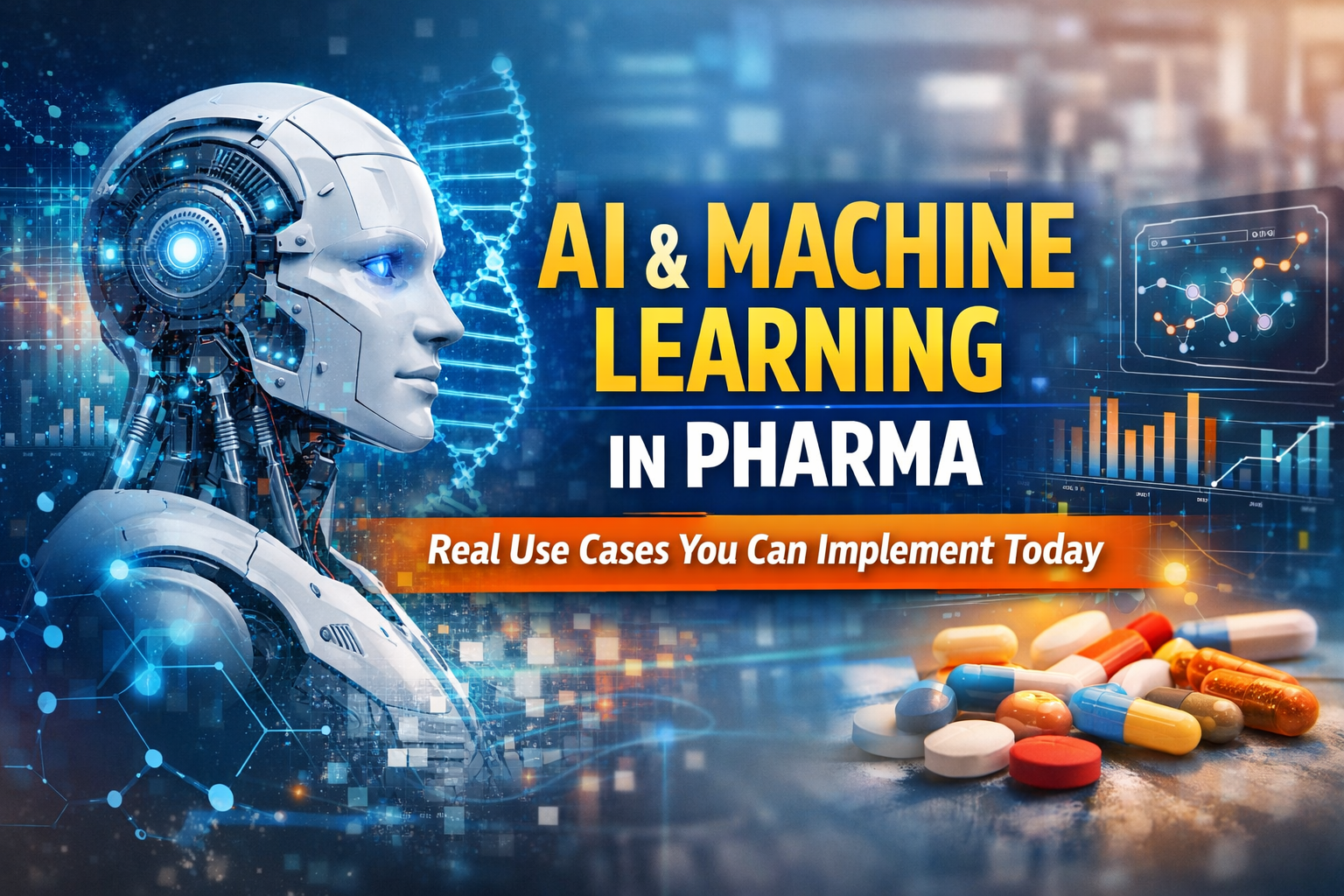
AI & Machine Learning in Pharma: Real Use Cases You Can Implement Today to Boost Compliance & Efficiency
🚀 Introduction: Pharma is Changing—Are You Ready?
The pharmaceutical industry is no longer just about manufacturing drugs—it’s about data, intelligence, and automation.
With increasing regulatory pressure, complex supply chains, and the demand for faster innovation, companies that rely only on traditional methods are falling behind.
This is where AI & Machine Learning in Pharma come into play.
From predictive maintenance to automated compliance tracking, AI is not a future concept—it’s already transforming pharma operations today.
And the best part?
👉 You don’t need a massive budget or a data science team to get started.
In this blog, we’ll break down real, practical use cases of AI & Machine Learning in Pharma that you can start implementing immediately.
📊 Why AI & Machine Learning in Pharma Are Game-Changers
Before diving into use cases, let’s understand why this shift is critical.
According to industry reports:
- 80% of pharma data remains unused
- Compliance-related errors cost millions annually
- Manual processes increase audit risks
AI helps solve these challenges by:
- Automating repetitive tasks
- Predicting risks before they occur
- Improving decision-making with real-time data
As highlighted in industry insights, the real challenge is not adopting technology—but closing the skill gap to use it effectively
🔬 Top Real Use Cases of AI & Machine Learning in Pharma
Let’s explore practical, implementable use cases that deliver real ROI.
🧠 1. Predictive Maintenance in Pharma Equipment
🔍 Problem:
Unexpected equipment failures lead to:
- Production downtime
- Batch losses
- Compliance risks
🤖 AI Solution:
Machine learning models analyze:
- Sensor data
- Equipment usage patterns
- Historical failures
✅ Result:
- Predict failures before they happen
- Schedule maintenance proactively
💡 Example:
A tablet compression machine shows vibration anomalies → AI alerts maintenance → downtime avoided.
📈 2. AI-Powered Quality Control & Deviation Detection
🔍 Problem:
Manual deviation detection is:
- Time-consuming
- Error-prone
🤖 AI Solution:
- Analyze batch data in real-time
- Detect anomalies instantly
✅ Benefits:
- Faster deviation detection
- Reduced human error
- Improved compliance
💡 Example:
AI detects unusual temperature variation in a sterile process → triggers alert → prevents batch rejection.
📊 3. Data Integrity & GMP Compliance Monitoring
🔍 Problem:
Regulatory audits demand:
- Accurate
- Traceable
- Tamper-proof data
🤖 AI Solution:
- Monitor data logs automatically
- Identify suspicious changes
- Ensure 21 CFR Part 11 compliance
✅ Outcome:
- Audit-ready systems
- Reduced compliance risks
🧪 4. Visual Inspection Automation (Particle Detection)
🔍 Problem:
Manual visual inspection:
- Depends on human judgment
- Leads to inconsistency
🤖 AI Solution:
- Computer vision detects particles
- AI classifies defects
🔬 Industry Insight:
Advanced inspection tools like Knapp Kits and automated inspection systems are used to train and validate defect detection in pharma environments
✅ Benefits:
- Higher accuracy
- Consistent results
- Faster inspections
🏭 5. Process Optimization & Yield Improvement
🔍 Problem:
Process inefficiencies reduce yield and increase cost
🤖 AI Solution:
- Analyze process variables
- Identify optimal parameters
✅ Result:
- Improved batch success rate
- Reduced wastage
💡 Example:
AI identifies optimal mixing time → increases product yield by 5–10%.
📦 6. Supply Chain Forecasting & Inventory Optimization
🔍 Problem:
- Overstocking → high cost
- Understocking → delays
🤖 AI Solution:
- Demand forecasting using ML
- Inventory optimization
✅ Benefits:
- Reduced stockouts
- Lower inventory cost
👨🔬 7. AI in Clinical Trials & Drug Development
🔍 Problem:
Clinical trials are:
- Expensive
- Time-consuming
🤖 AI Solution:
- Patient selection optimization
- Predict trial outcomes
✅ Impact:
- Faster drug development
- Reduced costs
🔄 8. Digital Twin for Pharma Operations
🔍 What is it?
A digital replica of your process or facility
🤖 AI Role:
- Simulates real-world scenarios
- Predicts outcomes
✅ Benefits:
- Risk-free experimentation
- Process optimization
⚙️ How to Start Implementing AI in Pharma (Step-by-Step)
You don’t need to transform everything overnight.
🪜 Step 1: Identify High-Impact Areas
Focus on:
- Quality
- Maintenance
- Compliance
🪜 Step 2: Start with Small Pilot Projects
Example:
- Predictive maintenance for one machine
🪜 Step 3: Use Existing Tools
You can start with:
- Power BI
- Tableau
- Python-based models
🪜 Step 4: Train Your Team
The biggest gap is skills—not technology
Upskilling in:
- Data analytics
- AI fundamentals
- Pharma compliance
is critical.
🪜 Step 5: Scale Gradually
Once results are proven:
- Expand across departments
- Integrate systems
💡 Practical Tips for Pharma Professionals
If you’re a working professional, here’s how you can leverage AI & Machine Learning in Pharma:
🔹 Start Learning Immediately
- Basics of AI
- Data analytics tools
🔹 Work on Real Case Studies
- Predictive maintenance
- Deviation analysis
🔹 Focus on Compliance + Data Combination
This is where maximum value lies.
🔹 Build a Portfolio
- Create dashboards
- Document projects
📚 Real-World Skills You Need (Industry Demand)
To succeed in AI & Machine Learning in Pharma, focus on:
- Data analytics (Power BI, Tableau)
- GMP & regulatory knowledge
- Process understanding
- Basic Python / automation
Programs like structured pharma training platforms are already helping professionals gain these skills through real-life case studies and industry use cases
❓ FAQ Section
❓ What is AI & Machine Learning in Pharma?
AI & Machine Learning in Pharma refer to using intelligent algorithms to analyze data, automate processes, and improve decision-making across pharmaceutical operations.
❓ Is AI replacing pharma jobs?
No. AI is augmenting roles, not replacing them. Professionals who upskill will have a competitive advantage.
❓ Do I need coding skills to start?
Not necessarily. Tools like Power BI and Tableau allow you to start without coding.
❓ What is the best use case to start with?
- Predictive maintenance
- Data analytics dashboards
- Deviation detection
❓ How can I learn AI for pharma?
You should focus on:
- Practical training
- Industry-specific case studies
- Hands-on implementation
🔚 Conclusion: The Future Belongs to Data-Driven Pharma Professionals
The pharmaceutical industry is entering a new era—where data-driven decision-making is the norm.
AI & Machine Learning in Pharma are no longer optional—they are essential.
Those who embrace this shift will:
- Grow faster in their careers
- Add more value to organizations
- Stay ahead of industry changes
🎯 Call to Action
If you want to master AI, data analytics, and digital transformation in pharma, now is the time to act.
👉 Learn how to implement real-world use cases, build dashboards, and become industry-ready with structured training:
🔗 https://gauravdakshini.com/courses/the-pharma-architect-master-class/
This program covers:
- AI/ML in pharma
- Power BI & Tableau
- GMP & compliance
- Real-life case studies
Take the first step toward becoming a future-ready pharma professional.
Your trusted partner for pharma skills, systems, and solutions.

