
No products in the cart.
AI/ML Validation in Pharma: A Practical GAMP 5 Risk-Based Framework
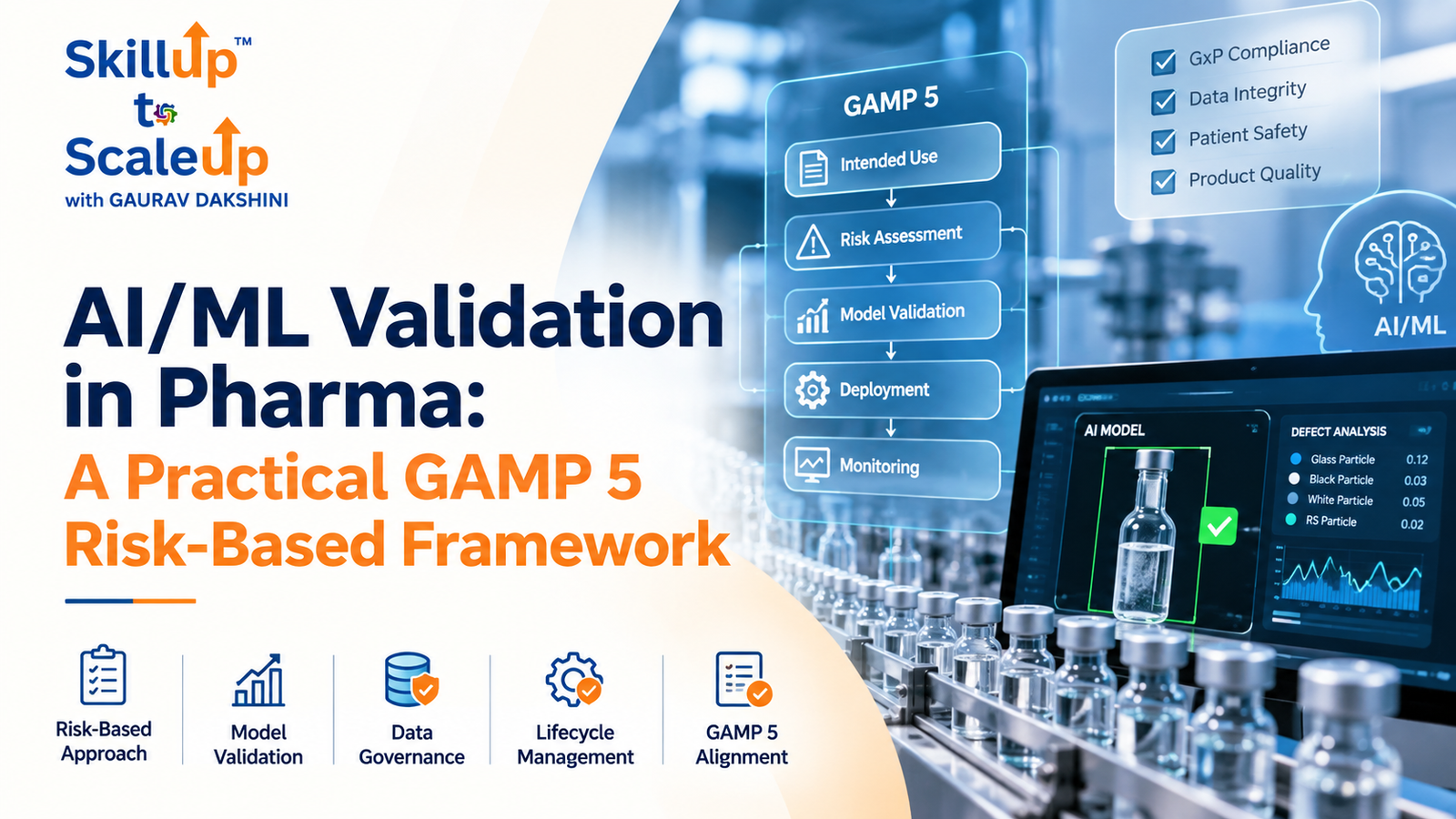
Artificial intelligence is moving rapidly from experimentation into real pharmaceutical operations.
AI and machine learning are increasingly being considered for applications such as visual inspection, process monitoring, predictive maintenance, deviation investigation, laboratory analytics, document review, forecasting, pharmacovigilance and manufacturing decision support.
But the moment an AI system influences a GxP process, product-quality decision, patient-safety decision or regulated record, an important question appears:
How do we demonstrate that the AI system is fit for its intended use?
Traditional computerized-system validation was largely developed around software where the same input is expected to produce a predictable output.
Machine-learning systems introduce additional complexity.
Their performance can depend on:
- training data;
- model architecture;
- feature engineering;
- operating conditions;
- data distribution;
- thresholds;
- model version;
- configuration;
- human interaction; and
- changes in real-world data over time.
For pharmaceutical companies, therefore, AI validation should not simply mean creating more validation documents.
The objective should be to establish sufficient evidence that the AI-enabled system performs reliably for its defined intended use and risk profile — and continues to do so throughout its lifecycle.
That philosophy aligns naturally with the risk-based principles behind GAMP 5.
This article presents a practical framework pharmaceutical organizations can use when approaching AI/ML validation.
Why Traditional Software Validation Alone Is Not Enough for AI
Consider a conventional rule-based application.
A requirement might state:
If parameter X exceeds the approved limit, generate an alarm.
The validation team can provide known inputs and verify that the expected alarm is generated.
Now consider an ML model trained to identify abnormal manufacturing patterns.
The requirement cannot realistically be:
Detect every abnormal process condition correctly.
The model operates statistically.
Its performance may instead need to be characterized using measures such as:
- sensitivity;
- specificity;
- precision;
- recall;
- false-positive rate;
- false-negative rate;
- accuracy;
- confusion matrices;
- confidence thresholds; and
- performance across representative operating conditions.
This changes the validation question.
Instead of asking only:
“Does the software execute the programmed requirement?”
we increasingly need to ask:
“Is there sufficient evidence that this model performs reliably within its intended context of use?”
That distinction is fundamental to AI validation in pharma.
Start With GAMP 5 Principles — Not With the Algorithm
One of the biggest mistakes organizations can make is beginning an AI validation project by discussing neural networks, model architecture or validation protocols.
Start with the business process.
GAMP’s risk-based philosophy focuses computerized-system assurance on protecting:
Patient Safety → Product Quality → Data Integrity
The first questions should therefore be:
- What process will the AI support?
- What decision will it influence?
- What happens if its output is wrong?
- Can a human detect the error before it affects a product or patient?
- Is the AI advisory or autonomous?
- What GxP records or decisions depend on it?
The answers determine the validation strategy.
A Practical 8-Step Framework for AI Validation in Pharma
Step 1: Define the Intended Use and Context of Use
Before validating an AI model, define exactly what it is expected to do.
A vague statement such as:
“The system uses AI to improve quality.”
is almost impossible to validate.
A better intended-use statement would describe the specific function, users, inputs, outputs and boundaries.
For example:
“The machine-learning model analyses historical and real-time process parameters to identify potentially abnormal operating patterns. The generated alert is reviewed by trained manufacturing personnel and does not independently change process parameters or determine batch disposition.”
That description immediately establishes important validation boundaries.
Document:
- intended users;
- business process;
- GxP relevance;
- input data;
- expected output;
- operating environment;
- interfaces;
- decision supported by the model;
- required human review;
- prohibited uses; and
- known limitations.
Validation becomes significantly easier when intended use is narrow and clearly defined.
Step 2: Perform a GxP Impact and AI Risk Assessment
Not every AI application requires the same level of assurance.
A useful risk model can consider:
Risk = Impact × Probability × Detectability
But AI systems should also be assessed for factors such as:
GxP Impact
Could an incorrect AI output affect:
- patient safety?
- product quality?
- batch disposition?
- critical process parameters?
- laboratory results?
- regulatory submissions?
- data integrity?
Decision Authority
Determine whether the AI is:
Informational
Provides information without recommending a GxP decision.
Advisory
Recommends an action but requires qualified human review.
Decision-supporting
Materially influences a regulated decision.
Autonomous
Executes or triggers an action without prior human approval.
Generally, the greater the model’s authority over a critical process, the stronger the assurance and control strategy should be.
Step 3: Validate the Data — Not Just the Model
In many AI projects, teams spend enormous effort validating model performance while paying insufficient attention to the data used to build it.
That is dangerous.
A sophisticated algorithm trained on unsuitable data can still produce unreliable results.
For GxP AI applications, establish documented controls around:
Data Provenance
Where did the data originate?
Can its source be traced?
Data Integrity
Are records complete, consistent and protected from inappropriate modification?
Representativeness
Does the training dataset represent actual operating conditions?
For example, a pharmaceutical visual-inspection model trained predominantly on one container format, lighting condition or defect population may perform differently when deployed under another.
Data Quality
Evaluate:
- missing values;
- duplicate records;
- incorrect labels;
- measurement errors;
- inconsistent formats;
- outliers;
- class imbalance; and
- anomalous records.
Dataset Separation
Where applicable, maintain appropriate separation between:
Training Data → Validation Data → Independent Test Data
Testing a model on the same observations used to train it can create misleading performance estimates.
Step 4: Establish Model Performance Requirements Before Testing
One of the most important principles in AI validation is:
Define acceptance criteria before evaluating the final model.
Otherwise, teams risk adjusting success criteria after seeing model performance.
Suppose an AI system identifies a particular defect.
Rather than specifying:
“The model should have good accuracy.”
define measurable criteria relevant to the intended use.
Possible measures include:
| Metric | What It Helps Evaluate |
|---|---|
| Sensitivity / Recall | Ability to identify true positive cases |
| Specificity | Ability to identify true negative cases |
| Precision | Reliability of positive predictions |
| False Positive Rate | Frequency of incorrect alerts |
| False Negative Rate | Frequency of missed conditions |
| Accuracy | Overall correct classifications |
| ROC-AUC | Discrimination across thresholds |
| F1 Score | Balance between precision and recall |
But no metric should be selected simply because it produces the most attractive number.
The appropriate metric depends on the risk associated with the model’s intended use.
For some pharmaceutical applications, for example, false negatives may carry substantially greater consequences than false positives.
The validation strategy should reflect that.
Step 5: Test the Model Against Representative and Challenging Conditions
AI validation should demonstrate more than average model performance.
A system can achieve excellent overall accuracy while failing badly on an important minority condition.
Testing should therefore challenge the model.
Consider:
Normal Operating Conditions
Does the model perform correctly during routine operation?
Boundary Conditions
What happens near classification thresholds or operating limits?
Rare Cases
Does the model encounter conditions poorly represented in training data?
Missing or Corrupted Inputs
What happens if a sensor value disappears or an upstream system provides unexpected data?
Out-of-Distribution Inputs
What happens when the AI receives data significantly different from its training population?
Subgroup Performance
Does performance remain acceptable across relevant:
- products;
- equipment;
- manufacturing lines;
- sites;
- batches;
- container types;
- operating ranges; or
- other scientifically meaningful categories?
The goal is not to prove that an AI system can never fail.
The objective is to understand where it performs reliably, where it may fail, and how those failures are controlled.
Step 6: Validate the Entire AI-Enabled System
An AI model is rarely deployed by itself.
A production implementation may look like:
Source System → Data Pipeline → Preprocessing → AI Model → Business Rules → User Interface → Human Decision → GxP Record
Validating only the model leaves significant risk uncontrolled.
For example, the model could be functioning perfectly while:
- incorrect data are mapped into it;
- preprocessing changes input values;
- an API sends the wrong model output;
- thresholds are configured incorrectly;
- results are displayed against the wrong batch;
- audit trails are incomplete; or
- user permissions allow unauthorized changes.
Therefore, pharmaceutical AI validation should address the complete computerized system and workflow, not simply the algorithm.
Step 7: Define Human Oversight
Human oversight is one of the most important controls for many current pharmaceutical AI applications.
But writing:
“Human-in-the-loop.”
is not sufficient.
The procedure needs to define what that actually means.
For example:
- Who reviews the AI output?
- What qualifications must that person have?
- Can the reviewer override the AI?
- Is the override recorded?
- Does an override require justification?
- What happens when AI and human decisions disagree?
- How are repeated disagreements investigated?
- Who has final decision authority?
A system where operators automatically accept every AI recommendation technically has a human in the workflow, but the control may provide little practical risk reduction.
Effective human oversight requires authority, competence, information and accountability.
Step 8: Maintain the Validated State
For traditional software, validation is sometimes treated as an event:
Implement → Validate → Release
AI requires stronger lifecycle thinking.
A model that performed acceptably when deployed may become less reliable when real-world conditions change.
This is commonly associated with concepts such as data drift and model drift.
Imagine a visual-inspection AI model trained using images from a particular:
- camera;
- illumination system;
- production line;
- product;
- container supplier; and
- defect population.
Later, the organization changes the camera or introduces a different container configuration.
The software may not have changed.
But the relationship between the model and its operating environment may have changed significantly.
The validated state therefore needs ongoing monitoring.
AI Validation Should Become a Lifecycle
A practical lifecycle might look like:
Intended Use
↓
GxP Impact Assessment
↓
AI Risk Assessment
↓
Data Qualification
↓
Model Development
↓
Independent Performance Evaluation
↓
System-Level Verification
↓
User Acceptance / Process Qualification
↓
Controlled Deployment
↓
Performance Monitoring
↓
Change Control / Periodic Review
↓
Retraining or Retirement
This is much closer to how pharmaceutical organizations should think about GAMP 5 AI validation.
Model Drift: The Validation Challenge After Go-Live
One of the major differences between AI and conventional software is that performance can deteriorate even without obvious code changes.
Suppose a predictive model was trained using two years of manufacturing data.
Six months after deployment:
- a raw-material supplier changes;
- equipment is recalibrated;
- operating ranges shift;
- sensors are replaced;
- product mix changes.
The incoming data distribution may gradually differ from the population used during model development.
That can affect model performance.
A monitoring strategy could therefore track:
- input-data distributions;
- missing-data frequency;
- prediction distributions;
- confidence levels;
- false-positive trends;
- false-negative trends;
- human overrides;
- exception rates;
- process changes; and
- model-performance indicators where ground truth becomes available.
Predetermined alert limits can trigger investigation.
What About Self-Learning AI?
This is where validation becomes significantly more complicated.
Consider two approaches.
Locked Model
The validated model remains unchanged after deployment.
New data can be collected, but the production model is updated only through controlled change management.
This creates a clear sequence:
Model v1.0 → Validation → Production
Then:
New Data → Retraining → Model v1.1 → Assessment/Validation → Controlled Release
Continuously Learning Model
The production model modifies itself automatically using new data.
Now the model validated on Monday may not be identical to the model operating on Friday.
This introduces difficult questions:
- What constitutes a model change?
- How is performance assessed before the new state influences GxP decisions?
- Can the previous version be restored?
- How are training datasets version-controlled?
- What triggers revalidation?
- Who approves the change?
For high-impact GxP applications, controlled model updates can therefore be substantially easier to govern than unrestricted continuous learning.
Change Control for AI/ML Systems
AI change control should extend beyond traditional software releases.
Potential changes include:
Model Changes
- algorithm modification;
- hyperparameter changes;
- new model architecture;
- new foundation model;
- changed classification threshold.
Data Changes
- additional training data;
- relabelled data;
- changed data source;
- changed preprocessing;
- new feature engineering.
Infrastructure Changes
- cloud environment;
- GPU/runtime;
- libraries;
- APIs;
- database;
- external AI service.
Process Changes
- new product;
- new equipment;
- different operating range;
- new manufacturing site;
- changed user workflow.
Each change should be assessed according to its potential effect on the system’s validated state.
Supplier Assessment Becomes Critical
Many pharmaceutical companies will not build their AI models completely in-house.
They may use:
- SaaS AI platforms;
- cloud ML services;
- commercial AI software;
- foundation models;
- third-party APIs;
- equipment containing embedded AI.
Supplier assessment therefore becomes increasingly important.
Questions should include:
- How does the supplier manage software and model versions?
- Can model updates occur without customer approval?
- How are changes communicated?
- What development controls are used?
- How is training data governed?
- What performance evidence is available?
- What cybersecurity controls exist?
- How are incidents managed?
- What audit trails are available?
- Can previous versions be restored?
- How is customer data protected?
- What happens when the underlying AI model is retired?
A validated implementation cannot rely solely on a supplier saying:
“Our AI is 99% accurate.”
The pharmaceutical organization still needs to determine whether the system is appropriate for its specific intended use.
What Documentation Does an AI Validation Package Need?
The exact documentation should be driven by risk rather than by a universal checklist.
For a higher-risk GxP AI application, documentation may include:
- intended-use specification;
- GxP impact assessment;
- AI/model risk assessment;
- system architecture;
- data-flow diagram;
- data-management plan;
- dataset description;
- data-quality assessment;
- model-development documentation;
- model version information;
- model-performance specification;
- test strategy;
- independent test results;
- system integration testing;
- traceability;
- supplier assessment;
- security assessment;
- human-oversight procedure;
- deployment record;
- monitoring plan;
- change-control procedure;
- incident-management procedure;
- periodic-review procedure; and
- retirement/archival strategy.
The objective is not maximum documentation.
The objective is sufficient documented evidence proportional to risk.
A Simple AI Validation Risk Matrix
A practical starting point can be:
| AI Use | GxP Impact | Human Oversight | Suggested Assurance |
|---|---|---|---|
| Internal knowledge search | Low | Yes | Basic controls |
| SOP drafting assistance | Low–Medium | Mandatory review | Controlled use |
| Deviation information retrieval | Medium | Yes | Moderate assurance |
| Predictive equipment maintenance | Medium | Yes | Risk-based validation |
| Visual inspection decision support | High | Yes | Extensive performance validation |
| Batch disposition recommendation | High | Strong oversight required | High assurance |
| Autonomous critical GMP decision | Very High | Limited/none | Requires exceptional justification and controls |
The important point is that “uses AI” is not itself the risk classification.
Risk comes from the intended use and the consequences of failure.
Generative AI and LLMs Create Another Validation Problem
Generative AI deserves special attention because the same prompt can sometimes generate different responses.
Large language models can also produce confident but incorrect statements.
Therefore, validation of a generative-AI system may need controls beyond traditional functional testing.
These can include:
- approved use cases;
- restricted knowledge sources;
- prompt controls;
- grounding mechanisms;
- output verification;
- hallucination testing;
- access controls;
- confidential-data controls;
- auditability;
- model/version management;
- human review;
- prohibited-use policies; and
- ongoing performance evaluation.
For example, using an LLM to help locate information in controlled documents is fundamentally different from allowing an LLM to autonomously approve a deviation.
Again:
Context of use determines risk.
What Regulators Are Signalling About AI
The regulatory direction is increasingly clear even though AI-specific expectations continue to evolve.
FDA has discussed the use of AI in pharmaceutical manufacturing and specifically raised questions around validation, maintenance of self-learning models and management of data used to develop AI systems.
FDA’s January 2025 draft guidance concerning AI used to support regulatory decision-making also introduced a risk-based credibility assessment framework tied to a model’s context of use.
EMA’s reflection paper on AI throughout the medicinal-product lifecycle similarly emphasizes areas including:
- human-centric AI;
- data governance;
- model performance;
- transparency;
- risk management;
- regulatory compliance; and
- lifecycle oversight.
ISPE has also expanded its GAMP body of knowledge with dedicated guidance addressing AI-enabled computerized systems.
The broader direction therefore does not appear to be:
“Create an entirely separate quality system for AI.”
A more practical interpretation is:
Extend established pharmaceutical quality, risk-management and computerized-system lifecycle principles to address the characteristics that make AI different.
10 Questions to Ask Before Deploying AI in a GxP Process
Before approving an AI implementation, management, QA, IT and validation teams should be able to answer:
- What exactly is the intended use?
- What happens if the AI is wrong?
- What data was used to develop and evaluate it?
- Is that data representative of our operating environment?
- What performance metrics actually matter for this use case?
- What are the predefined acceptance criteria?
- Where is human oversight required?
- How will model performance be monitored after deployment?
- What changes trigger reassessment or revalidation?
- Can we reconstruct which model, data, configuration and decision path produced a particular regulated output?
If these questions cannot be answered, the organization may not yet be ready to deploy that AI system in a critical GxP workflow.
The Biggest Mistake: Trying to Validate “AI”
You do not validate AI as a technology.
You validate a specific AI-enabled computerized system for a defined intended use within a defined operating environment.
That distinction matters.
The same underlying model might be acceptable for one application and completely inappropriate for another.
For example:
Using AI to summarize publicly available scientific literature carries a different risk from using AI to recommend batch disposition.
The technology might be similar.
The GxP risk is not.
From Computer System Validation to Continuous Assurance
The pharmaceutical industry’s AI journey may ultimately require a shift in mindset.
Instead of thinking only:
“Have we validated the system?”
organizations increasingly need to ask:
“Do we continue to have sufficient evidence that this system remains fit for its intended use?”
That means connecting:
GAMP 5 principles + Quality Risk Management + Data Governance + Model Governance + Human Oversight + Continuous Monitoring
into one lifecycle.
AI validation should therefore not become a documentation exercise designed simply to satisfy an audit.
Done properly, validation is what allows pharmaceutical organizations to adopt AI with confidence, control and scientific justification.
Final Thoughts
Artificial intelligence can create significant opportunities across pharmaceutical manufacturing, quality, laboratories, engineering and regulatory operations.
But innovation and compliance should not be treated as opposing forces.
A well-designed risk-based AI validation framework allows both.
Start with the intended use.
Understand the GxP impact.
Control the data.
Define measurable performance requirements.
Challenge the model.
Validate the complete workflow.
Establish meaningful human oversight.
Monitor the system after deployment.
Control changes.
And maintain evidence that the AI remains fit for its intended use.
That is how GAMP’s risk-based philosophy can evolve with AI without abandoning the principles that matter most:
patient safety, product quality and data integrity.
Frequently Asked Questions
What is AI validation in pharma?
AI validation in pharma is the documented process of establishing and maintaining evidence that an AI or machine-learning-enabled system is fit for its defined intended use within a pharmaceutical environment. The required assurance should be proportionate to the system’s GxP impact and risk.
Can GAMP 5 be used for AI validation?
Yes. GAMP’s lifecycle and risk-based principles provide a useful foundation for AI-enabled computerized systems. AI introduces additional considerations including training-data quality, model performance, bias, explainability, drift and ongoing monitoring.
Does every AI system used by a pharmaceutical company require full GxP validation?
No. The appropriate controls depend on intended use and GxP impact. An AI tool used for a non-GxP administrative activity has a different risk profile from an AI system influencing product-quality or manufacturing decisions.
How do you validate a machine-learning model in pharma?
Start by defining intended use and risk, qualifying relevant data, establishing predefined performance requirements, testing the model using representative independent data, challenging boundary and failure conditions, validating the complete system workflow and establishing post-deployment monitoring.
What is model drift in pharmaceutical AI?
Model drift refers to deterioration or change in AI performance as operating conditions or the relationship between inputs and expected outputs changes over time. Pharmaceutical AI governance should establish mechanisms to detect meaningful changes and determine when investigation, retraining or revalidation is required.
Can generative AI and LLMs be used in GxP environments?
Potentially, but the controls should reflect the intended use and associated risk. Because generative models can produce variable or incorrect outputs, appropriate applications may require controlled data sources, output verification, access controls, model/version governance, human review and ongoing performance monitoring.
Is a vendor’s AI validation certificate enough?
Generally, supplier documentation can contribute useful evidence, but the regulated company still needs to determine whether the implemented system is fit for its own intended use, configuration, process and risk environment.
Suggested Internal Linking
Link this article to future or existing GauravDakshini.com articles covering:
GAMP 5 → Computer Software Assurance → Pharma 4.0 → AI in Pharmaceutical Manufacturing → Data Integrity → Digital Transformation → Quality Risk Management → Generative AI in GxP
Is your organization experimenting with AI in a GxP environment?
The difficult part is rarely building the proof of concept. The real challenge begins when that model must operate inside a controlled pharmaceutical quality system.
The conversation should therefore start before deployment — with intended use, risk, data governance, validation strategy, human oversight and lifecycle controls.
Build AI for pharma with compliance designed in, not added later.

