
No products in the cart.
CSV vs CSA Pharma: 7 Powerful Differences Every QA Leader Should Know
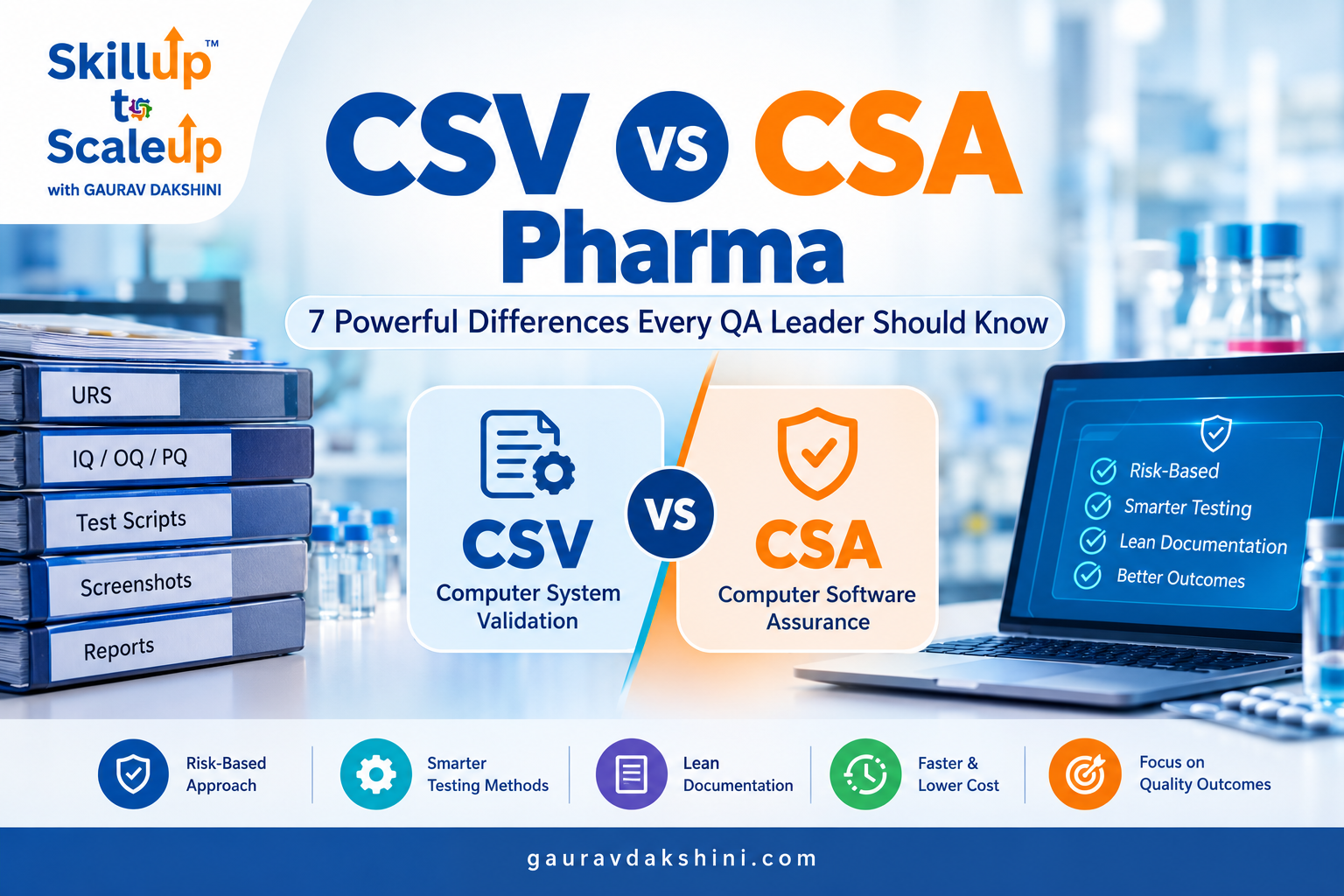
CSV vs CSA pharma is one of the most discussed topics in quality and compliance today. For over two decades, Computer System Validation (CSV) meant heavy documentation, screenshots and long test scripts. Now Computer Software Assurance (CSA) promises a smarter, risk-based way to prove that software is fit for its intended use.
So what really changes? In this guide, I break down CSV vs CSA in simple language, with a comparison table, real examples and a practical roadmap.

What Is CSV in Pharma?
Computer System Validation is the documented process of proving that a computerized system does what it is meant to do, consistently and reliably. It protects patient safety, product quality and data integrity.
Traditionally, CSV follows the V-model and includes:
- User Requirement Specification (URS)
- IQ, OQ and PQ protocols
- Detailed test scripts with expected results
- Screenshots as evidence
- Traceability matrices and summary reports
The intent is right. The problem is that many teams ended up validating everything equally, which created more paperwork than actual quality.
What Is CSA in Pharma?
Computer Software Assurance is a risk-based approach that focuses effort on what can actually harm patients or product quality. Instead of asking, “How much can we document?”, CSA asks, “What could go wrong, and how do we best gain confidence?”
CSA encourages critical thinking, smarter testing methods and leaner records. The goal is the same as CSV: trustworthy software. The path to get there is different.
CSV vs CSA Pharma: 7 Key Differences
1. Mindset: Documentation vs Critical Thinking
CSV often rewards documentation volume. CSA rewards good judgment. Your team decides what deserves deep testing and what needs only light assurance.
2. Risk Approach
In the CSV vs CSA pharma comparison, risk is the biggest shift. CSA separates high process risk features (for example, batch release logic) from low risk ones (for example, a report layout).
3. Testing Methods
CSV leans on scripted testing for almost everything. CSA allows:
- Scripted testing for high-risk functions
- Unscripted testing (ad hoc, error guessing, exploratory) for medium risk
- Vendor evidence for low-risk, well-established functions
4. Documentation
CSA does not mean “no documentation.” It means documenting what adds value: the risk rationale, the test approach, the results and any deviations. A tester’s signed note can replace ten pages of screenshots.
5. Use of Vendor Documentation
CSV teams often re-tested what suppliers already tested. CSA encourages leveraging trusted vendor audits, certifications and test records, so you avoid duplicated effort.
6. Speed and Cost
Because effort is aligned with risk, CSA usually reduces validation time and cost, and helps teams release software updates faster.
7. Focus on Quality Outcomes
CSV asks, “Is the paperwork complete?” CSA asks, “Does the system reliably support product quality and patient safety?”
CSV vs CSA Comparison Table
| Aspect | CSV (Traditional) | CSA (Modern) |
|---|---|---|
| Core approach | Document-heavy, uniform | Risk-based, focused |
| Testing | Mostly scripted | Scripted + unscripted |
| Evidence | Screenshots, wet signatures | Records fit for purpose |
| Vendor evidence | Often repeated | Leveraged where trusted |
| Effort | Same for all features | Scaled by risk |
| Mindset | Compliance-driven | Quality-driven |
Is CSA Approved by Regulators?
This is where many professionals get confused, so let me be precise.
The FDA’s Computer Software Assurance for Production and Quality System Software guidance was developed by CDRH (the medical device center) and was finalized in 2025. For drug manufacturers, the regulatory backbone remains 21 CFR Part 11, 21 CFR Part 211 and EU Annex 11. The good news is that the second edition of ISPE GAMP 5 already promotes the same critical-thinking, risk-based ideas, so pharma teams can apply CSA principles with confidence.
In short, the CSV vs CSA pharma discussion is not about replacing compliance. It is about meeting the same expectations in a smarter way. Always confirm your company’s interpretation with your QA and regulatory teams.
Useful references:
How to Move from CSV to CSA: A 5-Step Roadmap
Here is a simple path to apply CSV vs CSA pharma thinking in your organization.
- Identify the intended use. Define exactly what the software does in your process.
- Assess the risk. Ask whether a failure could affect patient safety, product quality or data integrity.
- Choose the right assurance activity. Match scripted, unscripted or vendor evidence to the risk level.
- Record what matters. Capture results, rationale and issues in a clear, concise way.
- Review and improve. Update your SOPs and train your teams to think critically.
If your team needs structured upskilling, explore our pharma validation and compliance training and our guide on data integrity in pharma.
(Replace the two internal links above with your actual post or service URLs.)
Common Mistakes to Avoid
- Treating CSA as “less testing.” It is better-targeted testing, not less responsibility.
- Skipping the risk assessment. Without it, you cannot justify lighter effort.
- Ignoring SOPs. Your procedures must allow unscripted testing and leaner records.
- Not training auditors and reviewers. Culture change matters as much as process change.
- Over-relying on vendors. Trust, but verify through supplier assessments.
Final Thoughts on CSV vs CSA Pharma
The shift from CSV to CSA is not a rejection of validation. It is an evolution toward quality that is measured by outcomes, not page counts. Teams that master CSV vs CSA pharma thinking will validate faster, spend smarter and stay inspection-ready.
If you want practical guidance on modernizing validation in your organization, connect with me at gauravdakshini.com.
FAQs
Is CSA replacing CSV in pharma?
CSA does not replace the goal of validation. It modernizes how you achieve it, using risk-based methods.
Does CSA reduce documentation?
Yes, it reduces low-value documentation while keeping meaningful records of risk, testing and results.
Can pharma companies use unscripted testing?
Yes, for lower-risk functions, if your SOPs allow it and the rationale is documented.
Which is better, CSV or CSA?
CSA is generally more efficient, but the right choice depends on your risk profile, systems and quality procedures.

