No products in the cart.
PMP Certification for Pharma Professionals: Top 10 Reasons to Boost Your Career in 2026
Introduction: Why Pharma Professionals Must Think Beyond Technical Skills
The pharmaceutical industry is evolving faster than ever. With increasing regulatory pressures, digital transformation, and complex global projects, technical expertise alone is no longer enough.
Today, organizations are actively looking for professionals who can lead projects, manage risks, ensure compliance, and deliver results efficiently.
That’s where PMP Certification for Pharma Professionals becomes a game-changer.
Whether you are in QA, QC, production, validation, engineering, or regulatory affairs—project management skills can dramatically accelerate your career.
In this blog, we’ll break down the top 10 reasons why PMP certification is becoming essential in pharma and how it can transform your professional journey.
What is PMP Certification? (Quick Overview)
PMP (Project Management Professional) is a globally recognized certification that validates your ability to:
- Lead and manage projects
- Handle cross-functional teams
- Control cost, time, and scope
- Ensure quality and compliance
For pharma professionals, this means managing:
- Validation projects
- Facility setups
- Regulatory compliance programs
- Automation and digital transformation initiatives
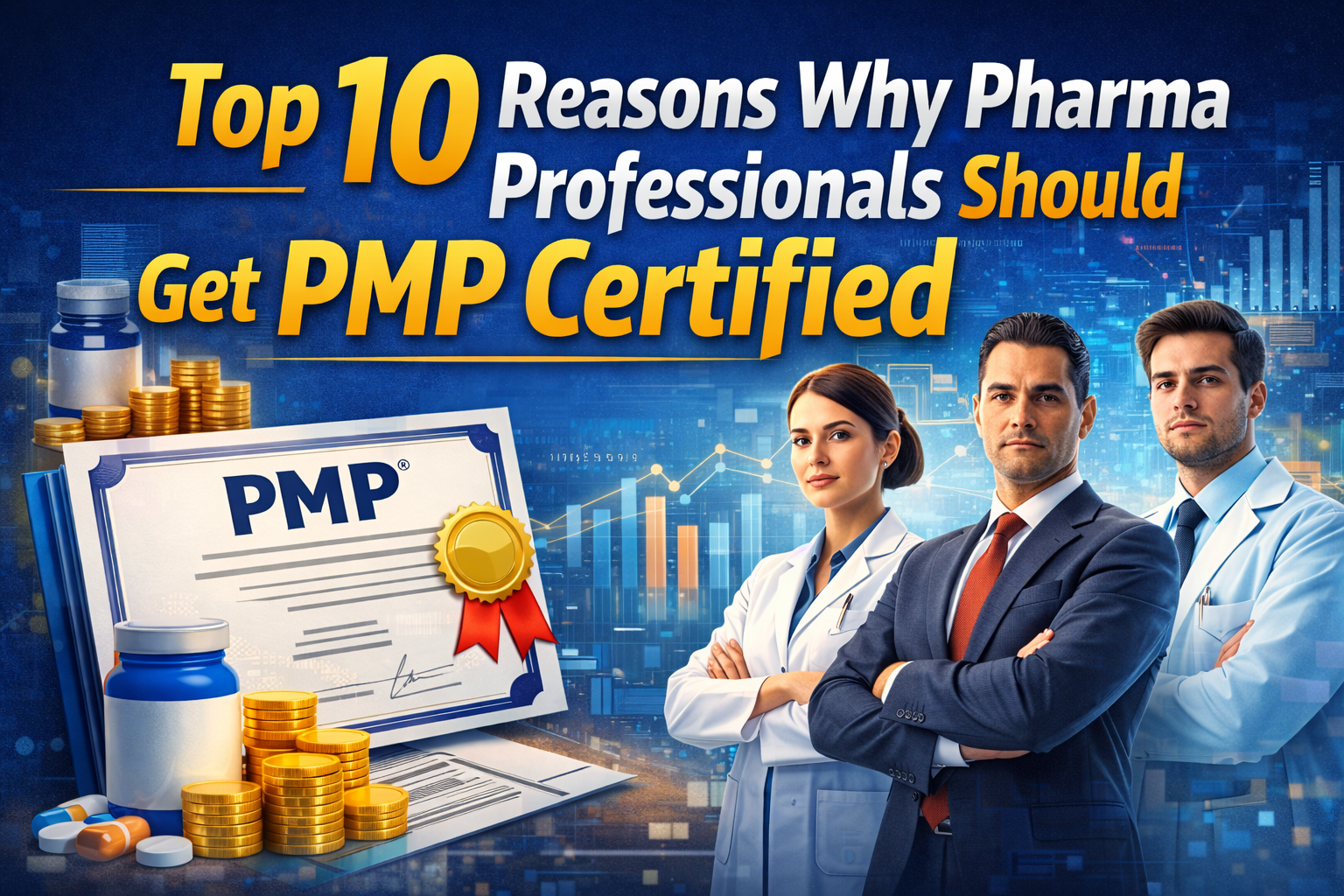
Top 10 Reasons Why Pharma Professionals Should Get PMP Certified
1. High Demand for Project Managers in Pharma
The pharmaceutical industry is heavily project-driven:
- New drug development
- Facility expansions
- Regulatory audits
- Digital transformation
Companies need professionals who can handle timelines, budgets, and compliance simultaneously.
👉 PMP certification gives you a competitive edge in high-demand roles.
2. Boost Your Salary Potential
Certified professionals often earn significantly more than non-certified peers.
In pharma:
- PMP-certified professionals can earn 20–30% higher salaries
- Leadership roles become accessible faster
This makes PMP Certification for Pharma Professionals not just a skill upgrade—but a financial investment.
3. Transition from Technical Role to Leadership
Most pharma professionals get stuck in technical roles for years.
PMP helps you move into:
- Project Manager
- Program Manager
- Operations Head
- Plant Leadership
It bridges the gap between execution and leadership.
4. Master Pharma-Specific Project Challenges
Pharma projects are unique because they involve:
- Regulatory compliance (FDA, EU GMP)
- Validation requirements
- Documentation-heavy processes
- Cross-functional coordination
With PMP, you learn structured approaches to manage:
- Risk assessment
- Quality control
- Change management
This aligns perfectly with industry needs highlighted in pharma training programs .
5. Global Recognition & Career Mobility
PMP is recognized worldwide.
Benefits include:
- Opportunities in MNC pharma companies
- Ability to work in global projects
- Better chances of international roles
You are no longer limited to local opportunities.
6. Improve Compliance & Audit Readiness
Compliance is the backbone of pharma.
With PMP, you learn:
- Documentation control
- Risk-based thinking
- Structured project execution
This directly supports:
- GMP compliance
- Audit preparedness
- Regulatory inspections
Organizations actively seek professionals who can align projects with compliance frameworks.
7. Learn Practical Tools & Frameworks
PMP teaches tools that are directly applicable in pharma:
Key Tools:
- Work Breakdown Structure (WBS)
- Critical Path Method (CPM)
- Risk Register
- Earned Value Analysis (EVA)
These tools help you:
- Deliver projects faster
- Reduce delays
- Control budgets
8. Stay Relevant in Industry 4.0 & Digital Pharma
Pharma is rapidly adopting:
- AI/ML
- Automation
- Data analytics
- Smart manufacturing
To manage these transformations, companies need project leaders—not just operators.
Programs like Skillup to Scaleup emphasize the importance of combining technology + management skills for future readiness .
9. Build Strong Leadership & Communication Skills
Technical knowledge won’t help if you can’t:
- Manage teams
- Communicate effectively
- Handle stakeholders
PMP focuses heavily on:
- Leadership mindset
- Stakeholder engagement
- Conflict resolution
These are critical for:
- Managing cross-functional pharma teams
- Handling audits and inspections
10. Future-Proof Your Career
The pharma industry is becoming:
- More regulated
- More competitive
- More technology-driven
Professionals without management skills risk becoming obsolete.
PMP ensures you stay:
- Relevant
- Competitive
- Future-ready
Real-Life Example: How PMP Transforms Careers
Let’s say you’re a QA professional.
Before PMP:
- Handling audits
- Writing documentation
- Limited growth
After PMP:
- Leading audit readiness programs
- Managing validation projects
- Driving compliance strategy
That’s the power of PMP Certification for Pharma Professionals.
Who Should Do PMP in Pharma?
This certification is ideal for:
- QA / QC professionals
- Production managers
- Validation engineers
- Regulatory affairs professionals
- Project engineers
- Automation & IT professionals
How to Get Started with PMP Certification
Step-by-Step:
- Understand PMP eligibility
- Enroll in a structured training program
- Study PMBOK concepts
- Practice mock exams
- Apply for PMP exam
- Clear the certification
Tips to Crack PMP Faster
- Focus on concepts, not memorization
- Solve mock tests regularly
- Learn real-life pharma use cases
- Follow a structured study plan
Common Mistakes to Avoid
❌ Studying without practical understanding
❌ Ignoring mock exams
❌ Not linking PMP concepts to pharma
❌ Delaying exam after preparation
FAQs
1. Is PMP useful for pharma professionals?
Yes, PMP helps pharma professionals move into leadership roles and manage complex projects effectively.
2. What is the salary increase after PMP?
Typically, professionals see a 20–30% increase in salary after certification.
3. Can QA/QC professionals do PMP?
Absolutely. PMP is highly beneficial for QA/QC roles, especially for audit and compliance projects.
4. How long does it take to prepare for PMP?
With proper guidance, you can prepare in 6–10 weeks.
5. Is PMP difficult to crack?
Not if you follow a structured approach with mock tests and practical understanding.
Conclusion: Your Next Big Career Move
If you’re serious about growing in the pharmaceutical industry, PMP Certification for Pharma Professionals is no longer optional—it’s essential.
It helps you:
- Earn more
- Lead projects
- Gain global opportunities
- Future-proof your career
🚀 Ready to Take the Next Step?
If you want structured guidance, mentorship, and real pharma use cases, explore the PMP Certification Training Program designed specifically for pharma professionals.
Start your journey today and move from execution to leadership.
👉 Your trusted partner for pharma skills, systems, and solutions.

