
No products in the cart.
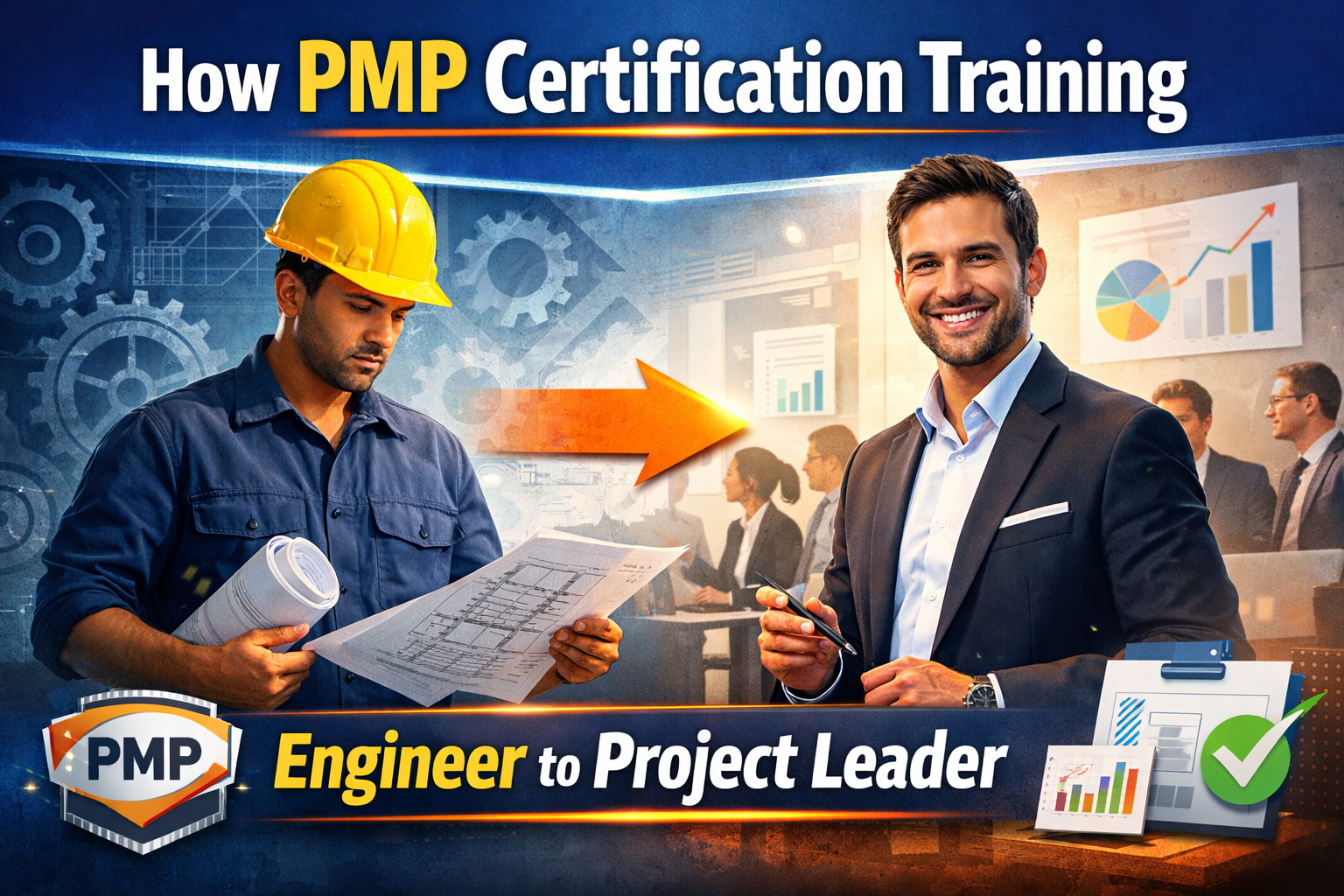
How PMP Certification Training Helps You Transition from Engineer to Project Leader
Introduction: From Technical Expert to Strategic Leader
You’ve mastered systems.
You’ve solved technical problems.
You’ve delivered results.
But here’s the question:
👉 Are you leading projects — or just executing tasks?
Many engineers hit a career ceiling after 5–8 years. Promotions slow down. Salary growth plateaus. Leadership roles seem reserved for “managers.”
The difference?
Structured project leadership skills.
This is where PMP Certification Training becomes a game-changer.
If you want to transition from engineer to project leader — confidently, globally, and strategically — this guide will show you how.
H2: Why Engineers Struggle to Move into Leadership Roles
Engineers are trained to:
- Solve technical problems
- Focus on precision
- Work independently
- Deliver within defined scope
Project leaders, on the other hand, must:
- Manage stakeholders
- Handle budgets
- Navigate risks
- Influence cross-functional teams
- Make strategic decisions
The skill gap is real.
And most engineers try to “learn leadership on the job.”
That approach is slow. Risky. And often limiting.
PMP Certification Training provides the structured bridge.
H2: What is PMP Certification and Why It Matters?
The PMP Certification (Project Management Professional) is a globally recognized credential issued by PMI (Project Management Institute).
It validates that you can:
- Lead projects
- Manage risk
- Control cost and schedule
- Align strategy with execution
- Drive measurable outcomes
Globally, PMP-certified professionals earn 16–25% higher salaries than non-certified peers.
But beyond salary — PMP changes how you think.
It transforms you from:
🔹 Task executor → Strategic decision-maker
🔹 Technical expert → Cross-functional leader
🔹 Individual contributor → Project owner
And that transformation begins with structured PMP Certification Training.
H2: How PMP Certification Training Transforms Engineers into Leaders
Let’s break this down practically.
H3: 1. You Learn the Language of Leadership
Engineers speak in:
- Specifications
- Calculations
- Drawings
- Validation protocols
Project leaders speak in:
- Scope
- Risk exposure
- Stakeholder alignment
- ROI
- Change impact
PMP Certification Training teaches you the global language of project leadership.
You learn:
- Project Charter development
- Stakeholder engagement plans
- Risk registers
- Cost baselines
- Earned Value Analysis (EVA)
Now, instead of saying:
“The system is delayed due to technical issues.”
You say:
“We are facing a schedule variance due to identified risk exposure; mitigation strategy is in place.”
That’s leadership communication.
H3: 2. You Develop Structured Decision-Making Skills
Engineers often rely on instinct + technical logic.
Project leaders rely on:
- Data-backed decisions
- Risk quantification
- Structured frameworks
Through PMP Certification Training, you master:
- Monte Carlo risk analysis
- CPI & SPI calculations
- Critical Path Method
- Fast tracking & crashing
- Change control process
This shifts you from reactive thinking to proactive strategy.
H3: 3. You Understand End-to-End Project Ownership
Many engineers only see:
- Their department
- Their deliverable
- Their task
But leaders see:
- Entire lifecycle
- Budget impact
- Regulatory compliance
- Stakeholder politics
- Cross-functional dependencies
Structured PMP Certification Training gives you:
- Integration Management
- Scope Management
- Cost Management
- Quality Management
- Resource Management
- Procurement Management
- Stakeholder Engagement
Now you don’t just “do your part.”
You own the project.
H2: Real Career Shift: Engineer → Project Leader
Let’s take a practical example.
Before PMP:
- Senior Engineer
- Managing technical execution
- Limited exposure to budgeting
- No stakeholder visibility
- Salary growth stagnant
After PMP Certification Training:
- Project Manager
- Managing ₹10–100 Cr projects
- Direct client interaction
- Risk ownership
- Leadership visibility
- Higher compensation band
The difference isn’t experience alone.
It’s structured certification + mindset shift.
H2: Why Choosing the Right PMP Certification Training Matters
Not all programs are equal.
If your goal is just clearing the exam — any course works.
If your goal is career transformation, you need:
- PMI Authorized Training Partner
- Practical case studies
- Real industry examples
- Application support
- Mock tests aligned with actual exam
- Career mentoring
The PMP Certification Training offered by Gaurav Dakshini stands out because:
- Authorized Training Partner by PMI Skillup to Scaleup Broacher ATP…
- 1200+ PMP concept slides Skillup to Scaleup Broacher ATP…
- 1200+ actual PMI-cloned questions Skillup to Scaleup Broacher ATP…
- Personalized step-by-step study plan Skillup to Scaleup Broacher ATP…
- Career support (LinkedIn + resume guidance) Skillup to Scaleup Broacher ATP…
- 35 PDUs with 5-day bootcamp Skillup to Scaleup Broacher ATP…
This is not just exam prep.
It’s leadership grooming.
H2: Key Leadership Skills You Gain Through PMP Certification Training
🔹 Strategic Thinking
Understand how projects align with business goals.
🔹 Risk Management
Quantify and manage uncertainties using structured tools.
🔹 Financial Awareness
Master CPI, SPI, Earned Value concepts.
🔹 Communication Mastery
Influence stakeholders across levels.
🔹 Conflict Resolution
Manage team dynamics professionally.
🔹 Time & Schedule Optimization
Handle fast tracking and crashing strategically.
These are executive-level skills.
H2: Why Engineers in Pharma & Manufacturing Need PMP More Than Ever
In regulated industries:
- Delays cost crores
- Audit failures damage reputation
- Poor documentation impacts compliance
Structured project management ensures:
- 21 CFR compliance
- Risk-controlled implementation
- Proper documentation lifecycle
- Audit readiness
That’s why leadership programs under Skillup to Scaleup focus heavily on structured project governance Skillup to Scaleup Broacher ATP….
H2: PMP Certification Training vs Learning “On the Job”
| On-the-Job Learning | PMP Certification Training |
|---|---|
| Random exposure | Structured framework |
| Trial & error | Proven methodology |
| Limited perspective | Global best practices |
| Slow career growth | Accelerated transition |
Engineers who rely only on experience grow linearly.
Engineers who combine experience + PMP grow exponentially.
H2: How to Know You’re Ready for PMP?
You’re ready if:
- You manage tasks but want ownership
- You coordinate teams unofficially
- You want leadership credibility
- You aim for global mobility
- You’re stuck at Senior Engineer level
The earlier you start PMP Certification Training, the faster your leadership curve rises.
H2: Practical Steps to Transition Successfully
Step 1: Assess Your Current Role
Are you already handling:
- Vendor coordination?
- Budget tracking?
- Team supervision?
If yes — you’re halfway there.
Step 2: Enroll in Structured PMP Certification Training
Choose an Authorized PMI Partner.
Step 3: Follow a Study Plan
- 2–3 months disciplined study
- Mock exams weekly
- Focus on mindset, not memorization
Step 4: Apply Concepts Immediately
Use:
- Risk registers in your current project
- Stakeholder matrix
- Earned Value tracking
Learning + application = leadership shift.
H2: Long-Term Career Impact of PMP Certification
After completing PMP Certification Training, you open doors to:
- Project Manager
- Program Manager
- Portfolio Manager
- Operations Head
- Plant Head
- Global roles
It builds credibility that no designation alone can give.
H2: Frequently Asked Questions (FAQs)
Q1: Is PMP Certification Training worth it for engineers?
Absolutely. It bridges the gap between technical execution and leadership ownership.
Q2: How long does PMP preparation take?
With structured PMP Certification Training, 8–12 weeks is sufficient.
Q3: Does PMP increase salary?
Yes. Industry data shows 16–25% higher average compensation.
Q4: Is PMP useful in pharma industry?
Extremely. It supports compliance-driven project execution.
Q5: Do I need prior project management experience?
Yes, PMI has eligibility criteria. Training providers guide you through application support Skillup to Scaleup Broacher ATP….
Conclusion: The Engineer Who Leads Wins
Technical excellence gets you hired.
Leadership excellence gets you promoted.
If you’re serious about transitioning from engineer to project leader, don’t wait for promotion to teach you leadership.
Invest in structured PMP Certification Training.
Build credibility.
Master frameworks.
Lead with confidence.
🚀 Ready to Transition from Engineer to Project Leader?
Explore the comprehensive, PMI-authorized PMP Certification Training program here:
👉 https://gauravdakshini.com/courses/pmp-certification-training/
Your next promotion may depend on it.
Your trusted partner for pharma skills, systems, and solutions.

